
By Charles West August 26, 2026
A franchise brand may want one processing relationship, one negotiated pricing framework, one POS standard, and one reporting dashboard—but each independently owned franchise location may still need its own merchant account, bank settlement, underwriting profile, and liability.
That tension is the central challenge in payments across a franchise system. The goal is not to centralize everything. It is to centralize the technology, standards, purchasing leverage, security expectations, and reporting that benefit the network while preserving the legal, financial, and operational separation that independently owned franchisees may require.
The most important principle is:
Corporate pricing negotiation does not equal corporate ownership of every merchant account.
Depending on the processor/acquirer, franchise agreement, ownership structure, and underwriting model, a franchisor may negotiate commercial terms for the network while individual franchisees still hold their own merchant agreements, operate under separate MIDs, receive deposits into their own bank accounts, manage their own chargebacks, and remain separately underwritten.
Centralized visibility therefore does not necessarily require centralized settlement, a shared merchant account, or franchisor control of franchisee funds.
This guide explains how franchisors and franchisees can evaluate franchise payment processing architecture, corporate-negotiated merchant rates, franchisee-owned MIDs, gateways, settlement, reconciliation, tokenization, PCI DSS responsibilities, ownership changes, and centralized reporting without confusing multiple independent businesses with a single merchant.
How Payments Work Across a Franchise System
Franchise payment processing becomes easier to design when every participant and identifier has a defined role. A franchise system may look unified to customers, but the payment infrastructure behind the brand can involve several separately owned businesses.
The franchisor owns or controls the franchise system and brand according to its agreements. A franchisee is the person or entity granted the franchise.
The Federal Trade Commission’s Franchise Rule governs specified disclosures to prospective franchisees and illustrates why the franchise relationship has its own contractual and regulatory structure rather than being treated simply as a collection of corporate branches.
The franchisee’s legal entity may be the corporation, LLC, partnership, or other entity operating a particular business. That legal entity may enter into a merchant agreement with an acquirer or payment provider.
A merchant account is the commercial acquiring relationship that allows the merchant to accept covered electronic payments. A merchant ID, or MID, is an identifier used within a processor/acquirer architecture to identify a merchant or merchant profile. The exact terminology and hierarchy vary among providers.
A location ID may identify a store inside a POS, gateway, processor, ERP, or reporting platform. A terminal ID generally identifies a payment endpoint or terminal. Neither term should automatically be treated as interchangeable with a MID.
A payment gateway handles payment-data capture, routing, and related transaction functions, while processing and acquiring functions operate behind it. For a useful overview of these different roles, see this guide to payment gateways versus payment processors.
The basic franchise payment flow may look like this:
Customer → Franchise Location → MID → Processor/Acquirer → Franchisee Settlement Account
The Federal Reserve’s explanation of the acquirer and settlement relationship also distinguishes an institution that provides merchant settlement from an entity that merely performs transaction-processing services.
A separate data flow can then operate alongside the money flow:
Location Transaction Data → Gateway/Processor → Corporate Reporting Layer → Franchise Dashboard
That second flow is crucial. Corporate finance can often receive consolidated data without being the entity receiving each franchisee’s settlement.
The Federal Reserve defines an acquirer, for purposes of Regulation II, as a person that contracts directly or indirectly with a merchant to provide settlement for electronic debit transactions over a payment card network; a processor that only provides processing is distinguished from the entity providing settlement.
Franchise Payment Processing Models

There is no single correct franchise payment architecture. The appropriate model depends on who owns the locations, which legal entities sell to customers, how the franchise agreement is written, what the acquirer will underwrite, and how the POS and gateway are configured.
Independent Processing vs. Corporate-Preferred Processing
At one end of the spectrum, each franchisee independently chooses its processor, gateway, equipment, and merchant pricing. This maximizes local autonomy but can make network-wide reporting, security controls, support, and fee benchmarking difficult.
A more coordinated model uses a corporate-preferred processor. Corporate negotiates a commercial framework, technology integrations, support procedures, and reporting requirements.
Each franchisee then applies under that framework and may receive a franchisee-owned MID tied to its legal entity and bank account.
A centralized gateway can add another layer of standardization. One franchise payment gateway may route transactions to different MIDs according to location while still producing a corporate dashboard. Whether a particular gateway supports this design must be confirmed with the provider.
Some processors also support parent-child hierarchies, chain identifiers, account groups, or other structures that roll multiple merchant profiles into one reporting environment. These hierarchy identifiers are not necessarily MIDs themselves.
Corporate-owned stores present a different case. If several locations are operated by the same corporate legal merchant, a processor may permit those locations to operate under a corporate merchant-account structure with appropriate location identification.
Payment-facilitator or marketplace arrangements are another distinct architecture. They should not be assumed to fit an ordinary franchise simply because the system wants centralized payments.
Visa’s Payment Facilitator Model illustrates that payment facilitation is a formal acquiring structure involving an acquirer, payment facilitator, and sponsored merchants rather than simply a conventional merchant account shared by unrelated sellers.
Visa describes payment facilitation as a formal acquiring model involving an acquirer, payment facilitator, and sponsored merchants; Mastercard likewise imposes specific payment-facilitator and submerchant requirements.
| Model | MID Ownership | Settlement | Corporate Visibility | Main Consideration |
| Fully independent | Franchisee/provider arrangement | Franchisee | Usually fragmented | Limited standardization |
| Preferred processor/separate MIDs | Individual franchisees | Direct to franchisee | Can be consolidated | Requires coordinated onboarding |
| Central gateway/separate MIDs | Individual merchants | Separate settlement | Strong potential roll-up | Gateway must support hierarchy/routing |
| Corporate-owned locations | Corporate entity or approved corporate structure | Corporate | High | Appropriate only for corporate-operated merchants |
| Approved split-funding model | Depends on provider structure | Allocated under approved setup | Potentially strong | Requires careful contractual, network, accounting, and legal review |
Corporate-Owned vs. Franchisee-Owned Locations
The distinction between corporate-owned and independently owned locations should be visible in the payment data model rather than hidden beneath a brand name.
| Area | Corporate-Owned Location | Franchisee-Owned Location |
| Legal entity | Usually franchisor or affiliate operating entity | Franchisee operating entity |
| MID ownership/control | May sit within corporate merchant structure | Often tied to franchisee merchant relationship |
| Settlement account | Corporate-approved account | Franchisee-approved bank account |
| Processing agreement | Corporate agreement or related structure | May be separately executed under negotiated program |
| Chargeback liability | Normally follows corporate merchant structure | Normally follows applicable franchisee merchant agreement |
| Corporate reporting | Direct | Can be provided through authorized roll-up |
These are architecture examples, not universal legal conclusions. Acquirer rules, franchise agreements, state law, contracts, and ownership structures can alter the arrangement.
The practical lesson is that a franchisor should define which payment elements must be consistent—POS software, gateway, terminal models, security configuration, reporting fields, perhaps even processor selection—without assuming that consistency requires the franchisor to become the merchant for every transaction.
Franchisee-Owned MIDs, One MID vs. Multiple MIDs, and Shared-MID Risk
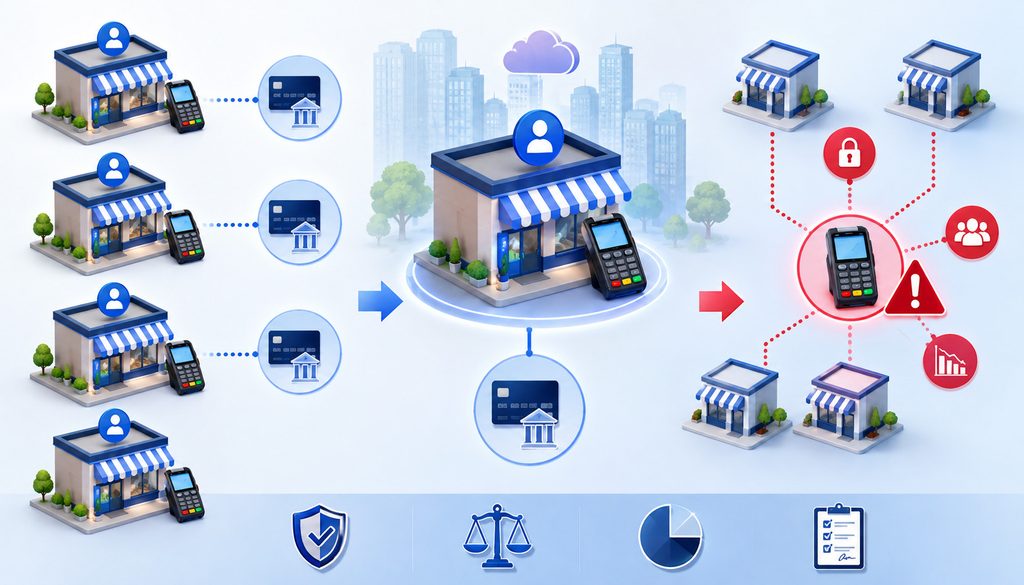
A franchisee-owned MID model lets an independently operated franchise participate in a standardized network payment program while preserving its own merchant relationship.
A typical franchisee may have its own legal entity, taxpayer information, ownership records, bank account, expected processing profile, underwriting approval, merchant agreement, MID, settlement, and dispute responsibilities. Corporate can still negotiate a payment-processing framework and receive authorized reporting.
What Is a Merchant ID in a Franchise System?
A merchant ID generally identifies a merchant or merchant processing profile within an acquiring environment. It helps the provider route, track, reconcile, and administer transactions, although its technical implementation differs among processors.
A franchise technology stack may simultaneously contain a corporate hierarchy ID, franchise-group ID, legal-entity identifier, store number, gateway merchant identifier, MID, terminal ID, and ecommerce channel identifier.
For example, Store 214 could have a POS location ID of 214, a corporate reporting key of SOUTHEAST-214, a processor MID, and six terminal IDs. None should be substituted for another simply because all ultimately refer to the same physical restaurant.
This distinction matters during chargebacks, reconciliation, data integrations, processor migrations, and franchise sales. When corporate reporting loses the connection between the legal entity, MID, and location, deposits and fees can easily be attributed to the wrong business.
A robust data model should therefore establish:
Corporate Brand → Franchise Group → Legal Entity → Location → MID → Terminal/Channel
The hierarchy may be simpler or more complex in practice, but every identifier should have a documented definition and owner.
When One MID May or May Not Make Sense
A single merchant-account structure can sometimes cover multiple locations operated by the same legal merchant when the processor/acquirer has approved that architecture. Separate locations can still be tagged through store, terminal, or reporting identifiers.
That does not mean unrelated independently owned franchisees should simply process through one MID for convenience or lower pricing.
Visa’s payment-facilitator documentation illustrates why processing transactions on behalf of other sellers is a recognized acquiring model with formal roles and obligations rather than merely an informal shared-account arrangement.
Using one merchant account for businesses that were underwritten as though they were one merchant can create several problems:
- the merchant profile may not accurately represent who is accepting the transaction;
- deposits belonging to different businesses may become mixed;
- chargebacks may hit the wrong economic party;
- reserves or holds may affect transactions beyond the intended location;
- merchant descriptors may confuse cardholders;
- tax and accounting records can become harder to defend;
- ownership changes become more complicated;
- processor records may no longer match the actual operating structure;
- termination or risk actions involving one merchant profile can have wider consequences.
A shared MID should never be used simply to bypass underwriting.
Separate MIDs, by contrast, can provide cleaner location-level funding, dispute responsibility, fee analysis, reconciliation, ownership transitions, and bank-account mapping. They can also preserve separation if one franchisee changes processors or sells its business.
The tradeoff is administration. A network with hundreds of separately underwritten merchants may face more applications, statements, bank mappings, support requests, and onboarding tasks.
Corporate-Negotiated Processing Rates Without Corporate Merchant Ownership

One of the biggest advantages of a franchise network is purchasing leverage. A franchisor can approach a processor with anticipated or historical system-wide volume and negotiate a standardized commercial framework.
The resulting corporate negotiated merchant rates may apply to franchisees that separately execute merchant agreements or enrollment documents, depending on the provider’s structure.
Corporate may negotiate:
- processor markup;
- per-transaction charges;
- gateway fees;
- account or platform fees;
- equipment pricing;
- implementation and deployment support;
- reporting tools;
- API access;
- chargeback-management services;
- support service levels;
- onboarding procedures;
- franchise-transfer procedures;
- termination provisions;
- data and token portability.
This can help with lowering merchant account fees across national franchise networks, but network volume does not transform independent businesses into one merchant for underwriting purposes.
When evaluating a provider, the system should examine more than an advertised percentage. A useful background resource is this guide to merchant-services pricing, security, reporting, and contract features.
Why Effective Rates Still Differ by Franchisee
Corporate can often standardize the pricing formula more easily than it can standardize the final effective processing rate.
Suppose two franchise restaurants both receive the same negotiated processor markup. Store A has mostly in-person debit and consumer-card transactions. Store B handles a larger share of online catering orders, premium rewards cards, and commercial-card payments.
Their processor markup can be identical while their total processing costs differ.
Variations may reflect:
- credit versus debit mix;
- consumer versus commercial cards;
- card-present versus card-not-present volume;
- average ticket;
- rewards and premium-card mix;
- ecommerce configuration;
- keyed transactions;
- refunds;
- chargebacks;
- acceptance technology;
- applicable network charges.
That is why the relationship can be summarized as:
Same negotiated contract ≠ same effective rate
For internal benchmarking, a franchise may calculate:
Effective Processing Rate = Total Included Processing Cost ÷ Card Volume × 100
The numerator must be defined consistently. If one franchise includes gateway, monthly, PCI-related, and chargeback fees while another counts only discount fees, the comparison is misleading.
Interchange-Plus, Blended Pricing, and Franchise Negotiation
With interchange-plus pricing, corporate may negotiate a consistent processor markup while underlying interchange and network costs vary according to actual transactions.
It would be inaccurate to promise one all-in rate simply because the processor markup is standardized.
Flat-rate or blended pricing can simplify forecasting and statement review, but it may conceal variation in underlying card costs. A franchise network should evaluate the total cost and contractual structure rather than assuming one pricing model is universally superior.
| Cost Layer | Corporate-Negotiated? | Varies by Location/Transaction? |
| Interchange | Generally not set by the processor | Yes |
| Network assessments/charges | Generally network-determined | Can vary |
| Processor markup | Often negotiable | Can often be standardized |
| Gateway fee | Often negotiable | May vary by usage |
| Monthly fee | Often negotiable | May vary by account |
| Hardware | Often negotiable | Depends on configuration |
| Chargeback fee | Often negotiable | Applied according to disputes/contract |
Aggregate franchise volume is therefore best understood as negotiating leverage, not as proof that every franchisee is the same underwriting risk.
Setting Up Individual Franchisee-Owned Merchant Accounts
A scalable franchise payment system should make opening a location predictable without disguising the fact that underwriting may occur at the franchisee level.
A practical onboarding workflow is:
- Define corporate payment, security, equipment, and reporting standards.
- Select the approved or preferred processor/acquirer arrangement.
- Create a standardized franchise onboarding process.
- Submit each applicable franchisee legal entity for underwriting.
- Assign the approved MID and reporting hierarchy.
- Connect the approved gateway and POS.
- Map the correct settlement bank account.
- Configure terminals, ecommerce channels, taxes, and refunds.
- Run test transactions and validate settlement.
- Enable appropriate corporate and franchisee reporting.
- Reconcile the first processor batches and deposits.
Franchisee Underwriting and New-Location Launches
Processors commonly request information such as the legal business name, ownership details, tax information, bank account, industry, estimated volume, average ticket, sales channels, and processing history. Exact requirements vary by acquirer and risk profile.
Underwriting is more than a paperwork exercise. Visa, for example, operates merchant-screening capabilities intended to help acquirers perform due diligence on prospective merchants and sponsored merchants.
A franchise-opening checklist should therefore start before the terminals arrive:
- legal entity established;
- merchant application submitted;
- approved bank account verified;
- MID created where required;
- location properly attached to corporate hierarchy;
- POS license and store ID established;
- approved payment hardware staged;
- gateway credentials assigned;
- ecommerce routing configured;
- refund roles established;
- reporting permissions created;
- PCI responsibilities identified;
- first-settlement reconciliation scheduled.
For larger networks, corporate should track these dependencies in an opening workflow rather than treating merchant activation as a final-day IT task.
Franchise Transfers and Resales
Separate merchant accounts can make franchise transfers operationally cleaner because the old owner’s processing can be closed or retained only for legitimate legacy activity while the buyer goes through new underwriting.
A MID or merchant agreement should not be assumed to transfer automatically with the physical restaurant, salon, hotel, or retail store.
When ownership changes, the new operator may require:
- new merchant underwriting;
- a new MID or updated approved merchant profile;
- a new settlement bank account;
- gateway and POS reassignment;
- token migration where supported;
- corporate hierarchy updates;
- procedures for old refunds and disputes;
- a formal transaction and settlement cutoff.
This prevents a buyer from unintentionally processing under the former owner’s merchant credentials.
Centralized Gateways, Online Ordering, Tokenization, and Merchant of Record
A multi-location payment gateway with corporate dashboard visibility can be one of the most useful franchise-system designs because it separates technology standardization from settlement ownership.
Conceptually:
Corporate Account → Franchise Group → Location → MID → Terminal/Channel
Corporate can standardize checkout APIs, payment applications, fraud controls, integrations, and reporting while each merchant transaction is routed to the correct location MID.
Modern payment platforms can also make POS, ecommerce, mobile payments, reporting, and integrations easier to coordinate. This overview of modern payment-processing technology and operational integrations provides additional context.
Corporate Visibility Without Corporate Fund Control
Corporate finance may legitimately need network-wide payment information such as card sales, refunds, processing fees, settlement totals, authorization results, and chargeback trends.
That does not mean corporate needs permission to initiate transfers from every franchisee’s settlement account.
Role-based access can separate visibility from financial control. A franchisor finance analyst might see aggregated sales and fees. The franchisee owner might see its own deposits and statements. A location manager might see transactions and refunds but not processing contracts or bank-account settings.
The principle of least privilege should apply to:
- franchisor finance;
- franchisee owners;
- accountants;
- store managers;
- IT administrators;
- customer-support personnel.
One franchisee generally should not see another independently owned franchisee’s confidential settlement or pricing information unless there is a legitimate authorized reason.
Tokenization and Card-on-File Across Locations
Tokenization can reduce the need for systems to handle raw card numbers, but not all tokens behave the same way.
A token may be:
- merchant-specific;
- MID-specific;
- gateway-specific;
- tied to a token vault;
- scoped to a payment-facilitator submerchant;
- an EMV payment token used under network tokenization architecture.
Mastercard Gateway documentation, for example, notes configurations in which separate token repositories are used for different submerchants. That illustrates why a franchise should never assume a token created for one merchant can automatically be charged by another.
The most important question for cross-location saved cards is:
Who is charging the card?
Imagine a customer saves a card while ordering from Franchisee A. Next month the customer visits Franchisee B and expects the same account to work.
The user interface may make this look like one brand, but the second transaction may involve another legal merchant, another MID, and another merchant agreement. The gateway, acquirer, network rules, customer consent design, and contractual structure all matter.
Network tokens are also distinct from ordinary gateway tokens. PCI SSC explains that EMV payment tokens can be used in place of the underlying PAN and operate with specific domain controls.
Token portability and sharing should therefore be confirmed in writing before building a franchise-wide wallet or card-on-file program.
Online Ordering, Split Funding, and Merchant of Record
Centralized ecommerce creates another key question: Which entity is the merchant for the customer order?
An online portal can potentially route each order to the correct franchise location MID based on fulfillment location. In another structure, a central entity might collect payments. These are economically and contractually different models.
A corporate ecommerce portal should define:
- who accepts the order;
- which legal entity is selling;
- which MID processes the card;
- where settlement goes;
- who issues refunds;
- which location owns the inventory or service;
- which entity handles disputes;
- what customer descriptor appears.
The term merchant of record should not automatically be assigned to the franchisor merely because corporate controls the website.
Split funding adds further complexity. Some approved payment architectures can allocate transaction proceeds among parties. Potential use cases could involve royalties, marketing fees, or platform charges, but capability alone does not establish that a particular franchise is permitted to use it.
Visa’s documentation treats receipt of settlement proceeds on behalf of underlying sellers as part of its formal payment-facilitator framework in certain circumstances. That is a strong reason not to improvise settlement aggregation simply to simplify royalty collection.
In many franchise systems, royalties can remain an accounting and franchise-billing process separate from card settlement.
PCI DSS, Access Controls, POS Standards, and Payment Data
Franchisors can standardize security expectations, but they should not assume that a corporate security program automatically eliminates every franchisee’s PCI DSS responsibilities.
PCI DSS applies to entities that store, process, or transmit cardholder data, as well as environments that can affect the security of payment account data.
PCI SSC specifically notes that outsourcing all payment processing does not eliminate a merchant’s responsibilities to understand its providers, maintain appropriate agreements, monitor service-provider compliance, and perform the applicable validation.
The exact responsibilities of a franchisor, franchisee, gateway, processor, POS provider, and other service providers depend on architecture and scope.
Shared POS Standards Are Not Shared Credentials
A franchise system can improve support and security by standardizing:
- approved terminals;
- payment applications;
- gateway integrations;
- POS versions;
- encryption or P2PE solutions where applicable;
- patching procedures;
- deployment configurations;
- incident-response requirements;
- device inventories;
- access-management policies.
Standardization should not mean giving every store the same administrator password or reusing sensitive API credentials among unrelated entities.
Corporate dashboards should use individual identities, strong authentication, and role-based access. Changes to settlement accounts, refund permissions, payment settings, and reporting exports should be logged.
This internal overview of transaction-security practices for modern payment environments can support broader security planning.
PCI SSC also emphasizes oversight of third-party service providers and shared responsibilities. Merchants need to understand which controls remain theirs and which are being performed by service providers.
Never Put Full PANs in Corporate Analytics
A corporate payment dashboard does not need full card numbers.
Reporting systems should rely on fields such as:
- masked card identifiers;
- processor transaction IDs;
- tokens where appropriate;
- card brand;
- card type;
- channel;
- location;
- MID;
- batch;
- settlement date;
- amount;
- fee;
- dispute status.
Full PAN should not become a reporting dimension in a corporate data warehouse merely because the organization wants cross-location analytics.
This reduces unnecessary exposure and helps keep the reporting environment separate from systems that genuinely need cardholder data.
Refunds, Chargebacks, Gift Cards, Loyalty, and Cross-Location Customer Experience
A nationally recognized franchise brand creates customer expectations that do not always align neatly with merchant-account boundaries.
A customer may buy at Franchise A and attempt to return the item at Franchise B. Another customer may buy online, pick up at one location, and request a refund through corporate support. Restaurant customers may expect gift cards and loyalty rewards to work anywhere.
Payment architecture needs to anticipate those scenarios.
Chargebacks and Refunds Should Map Back to the Merchant
With separate franchisee-owned MIDs, disputes should be traceable to the merchant account, legal entity, transaction, and location that accepted the payment.
Corporate can still create a franchise chargeback reporting dashboard:
| Location | Transactions | Chargebacks | Chargeback Amount | Reason Category | Status |
| Location A | Reporting data | Reporting data | Reporting data | Category | Open/Closed |
| Location B | Reporting data | Reporting data | Reporting data | Category | Open/Closed |
Corporate can use those roll-ups to identify trends, create evidence templates, train operators, or identify recurring operational problems without automatically taking over the franchisee’s contractual dispute responsibility.
The same principle applies to refunds. Where applicable and supported, the refund should be linked to the original transaction and merchant. Cross-location refunds require careful design because the store accepting the return may not be the merchant that received the original settlement.
A cross-location return policy needs to consider:
- original merchant identity;
- inventory movement;
- refund funding;
- sales-tax treatment;
- gateway capability;
- POS permissions;
- customer receipt history;
- franchise-to-franchise reimbursement.
A system should not assume that Franchise B can simply issue an electronic refund against Franchise A’s transaction.
Gift Cards and Loyalty Programs
Gift cards can create another network-wide obligation. If value purchased from one independently owned franchisee can be redeemed at another, the system needs rules for issuance, redemption, reimbursement, accounting, unclaimed-property obligations, and franchise settlement.
Those questions require qualified accounting and legal analysis and may vary by jurisdiction.
Loyalty is generally easier to centralize because points or customer profiles can exist at the brand level while each purchase still routes through the local merchant. Even then, discount funding and redemption economics should be defined.
Restaurant and hospitality systems should also review how tips and service charges are configured at each location because labor, tax, payroll, and merchant reporting consequences can differ.
The goal is a consistent customer experience without hiding who processed the transaction.
Centralized Franchise Payment Reporting and Consolidated Analytics
Centralized reporting is where a franchise network can gain many of the benefits of scale without centralizing the actual money.
A useful architecture is:
Location Transactions → MID Reports → Processor/Gateway Data → Corporate Data Warehouse/Dashboard → Franchise System Roll-Up
The reporting layer can combine data from hundreds of separate merchant accounts while maintaining the identifiers needed to trace every number back to its source.
What Corporate Reporting Should Capture
A strong franchise payment dashboard should generally capture:
- location;
- franchisee;
- legal entity;
- MID;
- gross card sales;
- refunds;
- net transaction volume;
- card-present/card-not-present mix;
- processing fees;
- deposits;
- chargebacks;
- authorization results;
- payment-method mix;
- average ticket;
- batch;
- settlement date.
A basic roll-up might look like this:
| Location | MID | Gross Card Sales | Refunds | Fees | Net Settlement | Chargebacks |
| Location A | MID-A | $— | $— | $— | $— | $— |
| Location B | MID-B | $— | $— | $— | $— | $— |
| Location C | MID-C | $— | $— | $— | $— | $— |
The values should come from actual processor and accounting records rather than estimates.
Gross Sales Are Not the Same as Bank Deposits
One of the most common reporting mistakes is treating settlement deposits as sales.
A bank deposit may be lower than gross card sales because of refunds, processing fees, chargebacks, reserve activity, adjustments, or timing differences. In other configurations, fees may be debited separately, causing deposits to look closer to gross volume.
Corporate should therefore report each layer independently:
Gross Card Sales → Refunds/Adjustments → Fees → Expected Settlement → Actual Deposit
The IRS’s Form 1099-K guidance reinforces the distinction between gross reportable payment amounts and deductions such as fees or refunds; for payment-card transactions, reporting rules focus on gross amounts rather than simply the net amount deposited.
Payment reporting does not replace franchisee-level tax records or accounting. Each entity should use qualified tax and accounting professionals for its specific obligations.
Comparing Processing Costs Fairly
Corporate benchmarking can help identify unusual pricing, gateway configuration, or channel mix, but comparisons should include context.
Useful metrics include:
- processor markup;
- effective processing rate;
- average ticket;
- card-present share;
- card-not-present share;
- refund rate;
- chargeback trends;
- authorization rate;
- gateway fees;
- monthly fees.
If Location A has a higher effective rate than Location B, the first question should not be, “Why is its processor overcharging?” It should be, “Which cost layers and transaction characteristics explain the difference?”
That distinction makes benchmarking more useful and less likely to create false conclusions.
Consolidated Reporting Software and Data Models
Useful features in consolidated financial reporting software for franchise payment processing include:
- multi-MID hierarchy support;
- legal-entity mapping;
- automated processor feeds;
- gateway APIs;
- scheduled file imports;
- customizable corporate and franchisee dashboards;
- fee normalization;
- settlement reconciliation;
- exports to accounting systems;
- role-based access;
- audit logs.
A foundational mapping is:
MID → Franchisee → Legal Entity → Location → GL/Reporting Entity
For a multi-brand operator, add brand explicitly rather than assuming one franchisee equals one brand.
APIs, scheduled reports, SFTP transfers, webhooks, and accounting integrations can all feed the corporate data platform. Webhooks are useful for near-real-time event visibility, but they should not replace final settlement reconciliation.
Settlement Reconciliation, Bank Accounts, and Bank-Change Controls
Franchise payment reconciliation should prove that recorded sales became the correct settlement for the correct merchant and reached the correct approved bank account.
The basic chain is:
POS Sales → Gateway → Processor Batch → Franchisee Bank Deposit → Accounting Ledger
A strong reconciliation process works in both directions. Finance should be able to start with a POS transaction and trace it to settlement, or start with a bank deposit and identify the processor batch and sales that created it.
Franchisee Settlement Reconciliation
A location-level reconciliation can use:
| Date | MID | Gross | Refunds | Fees | Expected Deposit | Actual Deposit | Difference |
| Date | MID | $— | $— | $— | $— | $— | $— |
Differences should have defined reason codes, such as timing, fee debit, chargeback, processor adjustment, reserve activity, or unresolved exception.
Corporate roll-up reconciliation should then confirm that aggregate corporate reporting equals the sum of properly mapped location data. It does not require placing unrelated franchisees’ deposits into one bank account.
Reporting differences can result from:
- POS business date;
- processor batch cutoff;
- local time zone;
- weekend or holiday banking;
- gateway timestamp;
- deposit date;
- late batch close.
A national franchise may therefore preserve the local business date while also converting timestamps into a standardized corporate reporting timezone.
Documented batch-closing procedures are particularly useful for systems in which location actions affect settlement timing.
Franchisee Bank Accounts and Bank-Change Fraud
Settlement should generally be directed to the bank account approved under the applicable merchant arrangement.
Bank-account changes deserve stronger controls than routine profile updates because an unauthorized settlement change can redirect legitimate revenue.
A secure bank-change workflow can include:
- authenticated requests;
- separate verification of the requestor;
- dual approval;
- callback verification using trusted contact information;
- audit logging;
- processor confirmation;
- review after the change takes effect.
Corporate’s role may vary. Some systems may give corporate visibility into bank changes; others may require approval; still others may deliberately leave control entirely with the independently owned franchisee and processor.
The correct model depends on contract, authority, and merchant ownership.
POS Standardization, Processor Contracts, Cost Control, and Franchise Governance
A franchise payment architecture is ultimately a governance system. Technology works only when everyone understands which decisions belong to corporate, the franchisee, and the payment provider.
A corporate-approved POS and payment stack can improve support, reporting consistency, security, hardware deployment, integrations, and customer experience.
The tradeoff is franchisee flexibility.
If franchisees can choose any processor, they may retain more local negotiating freedom but corporate may struggle to obtain standardized reporting and support. If one provider is contractually required, the franchisor needs to make sure the requirement is consistent with its franchise agreements, disclosures, applicable law, and operational commitments.
Whether a processor is required or merely preferred is therefore more than a technical distinction and should receive qualified franchise-law review.
Processor Portability and Contract Structure
A sophisticated system should ask whether a franchisee can change processors while retaining the corporate POS or gateway.
That depends on integration design. Some gateways are processor-agnostic; others are closely tied to one processing platform. Tokens, terminals, reporting APIs, and ecommerce configurations may also create dependencies.
Common contract structures can include:
- a master corporate agreement with franchisee enrollment;
- individually executed merchant agreements using corporate-negotiated terms;
- a preferred-provider or referral arrangement.
None is universally best.
Corporate should ask:
- Who signs the merchant agreement?
- Who bears merchant obligations?
- Who is underwritten?
- Who owns or controls the MID?
- Who receives settlement?
- Which rates are standardized?
- Who manages disputes?
- Who can terminate the account?
- Who controls gateway credentials and tokens?
- Who owns reporting data?
- What happens after a franchise sale or termination?
The franchisee should also understand whether it can change bank accounts, access statements, leave the processing program, export its data, obtain token portability where available, and maintain access to legacy refunds and disputes.
Corporate Negotiation Checklist
When negotiating franchise payment processing, evaluate:
- processor markup;
- per-transaction pricing;
- gateway costs;
- equipment;
- deployment;
- onboarding;
- reporting/API access;
- chargeback support;
- tokenization;
- service-level commitments;
- franchise transfer procedures;
- data portability;
- termination rights;
- reserve policies;
- bank-change procedures.
Legitimate cost-reduction strategies include aggregating network volume for negotiation, standardizing hardware and gateways, reviewing markup, removing unnecessary account charges, improving transaction-data quality, increasing appropriate card-present acceptance, and monitoring effective rates.
A headline percentage alone should never substitute for statement-level analysis.
Transparent franchise pricing also means separating network costs, processor fees, gateway costs, and any franchisor-related technology or service charges where applicable.
Franchise Ownership Changes, Multi-Brand Groups, Fraud Controls, and Common Mistakes
Payment architecture must survive organizational change. A franchise system may add stores, close stores, sell locations, reorganize entities, or have operators acquire multiple brands.
When a franchise changes owners, payment systems should not simply overwrite the owner name in a corporate location database.
A complete transition should address new merchant underwriting, MID requirements, bank accounts, tokens, POS reassignment, user access, reporting hierarchy, legacy chargebacks, refunds, and cutoff reconciliation.
When a location closes, stop new processing as appropriate but preserve authorized access for outstanding refunds, disputes, reports, and final settlement reconciliation. Remove unnecessary user credentials and update the corporate hierarchy so closed stores do not continue appearing as active merchants.
A franchisee opening another store may or may not need another MID. The answer depends on legal ownership, location setup, processor policy, sales channel, and reporting requirements.
For multi-brand franchisees, use a hierarchy such as:
Corporate Brand → Franchise Group → Legal Entity → Location → MID
Do not rely solely on the owner’s name, because one ownership group may operate multiple legal entities and brands.
Fraud controls can also be standardized at the system level. Corporate may establish baseline requirements for ecommerce fraud tools, refund permissions, POS security, administrator authentication, bank-change verification, and dispute documentation while individual merchants maintain additional controls appropriate to their risk.
Customer descriptors should help cardholders recognize both the brand and transaction where permitted by the processor. Descriptor configuration should be approved rather than assuming every independently owned franchisee can use exactly the same descriptor.
Common franchise payment mistakes include:
- putting unrelated franchisees on one MID merely for convenience;
- confusing a POS location ID with a MID;
- assuming corporate pricing means corporate merchant ownership;
- centralizing customer funds without an approved structure;
- skipping franchisee-level underwriting;
- using bank deposits as sales reports;
- leaving unknown MIDs unmatched in corporate reporting;
- failing to reconcile fees and deposits by location;
- giving corporate users excessive access to payment information;
- letting a new owner reuse old merchant credentials without approval;
- assuming all locations should have identical effective rates;
- building corporate reports around one provider’s terminology without a normalized data model;
- assuming gateway tokens work across franchisee MIDs;
- neglecting refund and dispute access after ownership changes.
Franchise Payment Architecture and Setup Checklists
A final architecture review should connect legal ownership, payment routing, settlement, technology, security, and reporting.
| Area | Verified? |
| Legal entity per location | |
| MID ownership/control | |
| Processor agreement | |
| Corporate negotiated pricing | |
| Bank settlement mapping | |
| Gateway hierarchy | |
| POS configuration | |
| Tokenization scope | |
| PCI responsibility | |
| Corporate reporting access | |
| Location reporting access | |
| Refund responsibility | |
| Chargeback responsibility | |
| Bank-change controls | |
| Franchise-transfer process | |
| Settlement reconciliation | |
| Data retention |
A useful payment-performance dashboard can then give each party the appropriate view:
| Metric | Corporate View | Franchisee View |
| Card sales | System and authorized location roll-ups | Own locations |
| Effective rate | Benchmarking with context | Detailed own-account view |
| Authorization rate | System trends | Own channels |
| Refunds | Trend reporting | Transaction-level own data |
| Chargebacks | Network trends | Own cases |
| Deposits | Authorized reconciliation visibility | Own settlement detail |
| Fees | Comparative/authorized analysis | Own statements and detail |
When evaluating a processor, ask specifically:
- Can each franchisee have its own MID under corporate-negotiated pricing?
- Can each franchisee receive settlement directly?
- Can corporate receive consolidated reporting without controlling funds?
- Can the reporting platform roll up multiple MIDs?
- Can separately underwritten merchants receive standardized pricing terms?
- How are franchise sales and ownership transfers handled?
- Can franchise groups have separate hierarchy levels?
- How are chargebacks routed?
- How are refunds across locations handled?
- Can one gateway support multiple franchisee merchant accounts?
- Are gateway tokens portable or usable across MIDs, and under what conditions?
- Can online orders route automatically to the appropriate MID?
- Is split funding supported, and what acquiring structure is required?
- How are settlement-bank changes authorized?
- Can corporate export transaction, fee, and settlement data?
- What happens to transactions, tokens, refunds, and reporting when a franchisee leaves?
Franchisors should separately decide:
- whether the processor is required or preferred;
- who negotiates rates;
- who owns or controls each merchant relationship;
- who receives settlement;
- which payment data corporate may access;
- which POS and gateway standards apply;
- how ownership changes are handled;
- who provides franchisee payment support;
- how disputes are escalated;
- which payment KPIs belong in network reporting.
These decisions should be documented before implementation rather than discovered through exceptions after the network grows.
Frequently Asked Questions
Should every franchise location have its own merchant ID?
Not necessarily. Whether another MID is needed depends on the legal entity operating the location, the merchant agreement, processor/acquirer architecture, sales channels, and reporting requirements.
Multiple stores owned by the same merchant may sometimes operate through an approved multi-location structure. Independently owned franchisees, however, should not be placed on one shared MID merely because they use the same brand. The processor/acquirer should confirm the appropriate merchant and location structure during underwriting.
Can a franchisor negotiate processing rates for independently owned franchisees?
Yes, a franchisor may be able to negotiate a commercial framework that participating franchisees receive, provided the processor supports that arrangement.
The franchisees can still be separately underwritten, maintain their own merchant agreements or enrollments, receive settlement directly, and bear responsibilities under their respective merchant arrangements. Negotiating purchasing terms for a network does not by itself make the franchisor the owner of every MID or merchant account.
Who owns the MID in a franchise system?
There is no universal answer. The MID is issued and administered within the processor/acquirer architecture and typically corresponds to a particular merchant relationship or profile.
For an independently owned franchise, that profile may be tied to the franchisee’s legal entity. Corporate-operated stores may instead exist within a corporate merchant structure. The merchant agreement, underwriting records, processor configuration, and legal ownership—not simply the brand name—should determine the answer.
Can multiple franchisees share one MID?
Independent franchisees should not simply share a conventional MID as a shortcut around separate underwriting.
There are formal acquiring structures, including payment-facilitator arrangements, that can support transactions for multiple underlying sellers, but those involve specific contractual and network requirements. A franchise should not assume it can recreate that model informally by depositing unrelated franchisee transactions into one merchant account.
What are the risks of a shared MID across franchise locations?
An inappropriate shared MID can create underwriting mismatches, settlement commingling, confusing customer descriptors, difficult chargeback allocation, accounting complications, reserve exposure, poor reporting, and problems when a franchise is sold.
The risk is particularly significant when separately owned entities are represented to the processor as though they were one merchant. Separate MIDs or an explicitly approved multi-merchant structure usually provide cleaner ownership and transaction mapping.
Can corporate see payment reports if franchisees own their merchant accounts?
Yes, where the processor, gateway, contracts, and permissions support it.
A centralized franchise payment reporting platform can collect authorized transaction, fee, settlement, refund, and dispute information from numerous franchisee-owned MIDs.
Reporting access does not inherently require corporate to receive or control the franchisees’ settlement funds. Role-based permissions should limit each user to the information needed for legitimate business purposes.
Can one payment gateway support multiple franchisee MIDs?
Some gateways can support multiple merchant accounts, hierarchical reporting, or transaction routing, but capabilities vary significantly.
A franchise should confirm how the provider maps corporate accounts, locations, merchant credentials, ecommerce channels, tokens, refunds, and reporting. Never assume a gateway’s ability to display several locations means those locations can legally or technically process under the same merchant credentials.
How do franchise systems create centralized payment reporting?
Start with a reliable mapping of franchisee → legal entity → location → MID. Import processor or gateway data through approved APIs, scheduled reports, secure file delivery, or accounting integrations.
Normalize fields such as transaction IDs, gross sales, refunds, fees, batches, deposits, and chargebacks. Then roll location records into corporate analytics while retaining the source MID. Corporate totals should equal the sum of valid mapped merchant records rather than the contents of a single bank account.
Do all franchise locations pay the same effective processing rate?
Usually not, even when they receive the same pricing formula.
Locations can have different consumer card mixes, average tickets, debit usage, ecommerce volume, keyed transactions, commercial cards, refunds, and chargebacks. Those factors affect the total processing cost. Corporate can standardize processor markup more readily than it can standardize each franchisee’s final effective rate.
Can franchisee deposits go directly to each franchisee’s bank account?
Yes, an architecture with separate franchisee merchant accounts can generally be designed so settlement is directed to each merchant’s approved bank account, subject to the processor/acquirer’s setup.
Corporate reporting can receive the transaction and settlement data separately. This is an important example of how centralized visibility can exist without centralized possession of franchisee funds.
How do chargebacks work with separate franchisee MIDs?
A chargeback is generally associated with the merchant transaction and merchant account through which the original payment was processed.
Corporate may monitor chargeback patterns across the network and provide training, tools, templates, or escalation support. The actual financial responsibility and dispute process should follow the applicable merchant agreement and transaction architecture rather than automatically being transferred to corporate.
Can a customer receive a refund at a different franchise location?
Potentially, but it should not be assumed.
If Franchise A processed the original transaction and Franchise B is independently owned, the POS and gateway may not allow Franchise B to refund Franchise A’s transaction. Even when a brand designs a cross-location return program, it must address the original merchant, inventory, tax treatment, settlement, reimbursement, permissions, and customer experience.
What happens to payment processing when a franchise changes owners?
The buyer should generally go through the processor’s required merchant onboarding and underwriting process. A new MID or merchant profile may be required, and the new settlement bank account must be approved.
The transition should also address POS access, gateway credentials, token portability, open refunds, chargebacks, reporting, and final reconciliation. The old merchant account should not simply be handed to the new legal owner without processor approval.
Can franchise royalties be automatically deducted from card settlement?
Some approved payment structures can support split settlement or automated allocations, but a franchisor should not assume it has an automatic right or technical ability to deduct royalties from a franchisee’s card settlement.
The processor/acquirer structure, card-network requirements, merchant agreements, franchise agreement, accounting treatment, and applicable law all need review. Many systems instead calculate and collect royalties separately from merchant settlement.
What should a franchisor ask before choosing a payment processor?
Ask whether franchisees can retain separate MIDs and bank settlement while participating in corporate-negotiated pricing and consolidated reporting.
Also evaluate gateway hierarchy, POS compatibility, token portability, ecommerce routing, transfer procedures, refund and dispute handling, bank-change controls, reporting exports, contract termination, equipment, security responsibilities, API capabilities, and support.
The strongest provider is the one whose architecture matches the franchise’s actual ownership model rather than forcing the ownership model to fit the technology.
Conclusion
The most effective franchise payment architecture is not necessarily the most centralized one. It is the architecture that centralizes the things a network benefits from sharing while preserving the legal and financial boundaries that should remain distinct.
A franchisor can negotiate merchant pricing, standardize POS and gateway technology, establish security requirements, create system-wide reporting, benchmark effective processing costs, and monitor refunds or chargebacks without necessarily becoming the merchant receiving every franchisee’s funds.
For independently owned locations, a strong model often begins with accurate legal-entity underwriting and a correctly assigned franchisee-owned MID, followed by direct location settlement and a separate corporate reporting feed.
The design can then build upward:
Franchisor Standards → Processor/Acquirer Relationship → Franchisee Legal Entity → Location MID → Gateway/POS → Customer Transaction → Location Settlement → Corporate Reporting Feed → Consolidated Analytics
Whatever model is selected, the organization should be able to answer three questions for every payment: Who sold to the customer? Which merchant account processed the transaction? Where did the settlement go?
If those answers are clear, corporate-negotiated rates, centralized franchise payment reporting, multi-location gateways, reconciliation, ownership changes, security controls, and network-wide analytics become much easier to manage.
This article provides general informational guidance rather than individualized legal, tax, accounting, franchise, PCI, or payment-contract advice.
Franchisors and franchisees should confirm their specific architecture, merchant-account responsibilities, settlement arrangements, tokenization capabilities, franchise obligations, and reporting requirements with their processor/acquirer and qualified legal and accounting professionals.