
By Charles West August 26, 2026
Changing payment processors is easy if every customer enters a card at every checkout. It becomes much harder when thousands of customers expect subscriptions, memberships, invoices, or repeat purchases to continue using a saved payment method.
A poor migration can turn a processor switch into failed renewals, involuntary churn, support tickets, duplicate charges, and forced card re-entry.
The good news is that changing payment processors does not automatically mean every customer must enter a card again.
In many environments, eligible card-on-file credentials can be securely transferred from one PCI-compliant provider to another and tokenized in the new vault. In other cases, an existing gateway or independent vault can remain in place while only the downstream processor changes.
But there is no universal portability rule.
A “saved card” might actually be a raw primary account number (PAN) protected inside a compliant vault, a processor-specific token, a gateway token, a merchant-controlled reference, a network token, a digital-wallet token, or a credential managed by a third-party subscription platform. Those credentials have very different migration characteristics.
The central principle is equally important:
Token portability depends on who controls the vault, what type of token is being used, what the outgoing provider will export, what the incoming provider can import, and whether a secure PAN-to-token re-tokenization process is available.
Merchants should investigate these questions before signing the replacement processing agreement. Discovering after termination that a token vault cannot be exported is one of the most expensive ways to learn how a payment architecture works.
What Does Switching Payment Processors Actually Mean?
“Switching payment processors” sounds like one technical change, but a merchant’s payment stack may contain several independent layers. A business could change its acquiring relationship while keeping its gateway, replace the gateway but retain its billing system, move the token vault, replace a subscription platform, or change several components simultaneously.
Understanding those boundaries is the first step in a successful payment processor migration.
A typical environment may contain:
- a merchant acquirer;
- a backend payment processor;
- a payment gateway;
- a payment orchestration layer;
- a PCI-compliant token vault;
- a subscription or recurring-billing platform;
- account updater services;
- network-token services;
- fraud tools;
- wallets;
- ERP, CRM, ecommerce, or marketplace integrations.
A gateway and processor are not automatically the same component. A gateway commonly handles the acceptance and transmission layer, while processing and acquiring functions handle routing, authorization, clearing, and settlement.
This distinction matters because a merchant may sometimes switch processors without replacing the gateway or the gateway’s token vault. For additional background, see this explanation of the difference between a payment gateway and payment processor.
| Component | Main Role | Why It Matters During Migration |
| Acquirer/processor | Routes and processes transactions and supports settlement | A new processor can change authorization, reporting, MID and settlement behavior |
| Payment gateway | Connects checkout or applications to payment processing | Gateway changes can affect APIs, tokens, webhooks and hosted checkout |
| Token vault | Protects payment credentials and maps tokens to underlying credentials | Whoever controls the vault strongly influences portability |
| Billing platform | Maintains subscriptions, plans, dates, retries and customer billing state | Card migration alone does not preserve recurring billing logic |
| Network token service | Issues and manages payment tokens through card-network tokenization infrastructure | Provisioning, domain controls and lifecycle-management relationships may need separate handling |
What Is a Card-on-File Customer?

A card-on-file customer is a customer whose eligible payment credential has been retained for future transactions under an applicable payment relationship and card-network requirements.
Common examples include SaaS subscriptions, streaming services, memberships, recurring invoices, ecommerce accounts, hospitality deposits, marketplace purchases and B2B customer accounts.
A card-on-file arrangement is more than a database field containing something called a token. The merchant must understand how the credential was established and how later transactions are initiated.
Visa’s current rules distinguish processing scenarios involving stored credentials and require appropriate treatment of subsequent transactions, including recurring and unscheduled credential-on-file transactions.
The initial establishment of a stored credential relationship and subsequent transaction processing are therefore important parts of migration planning, not merely technical token replacement.
Stored Credentials and Customer Consent
Stored-credential relationships may involve an initial customer-initiated transaction followed by later customer-initiated or merchant-initiated transactions.
Examples include:
- a customer logging in and purchasing with a saved card;
- a monthly subscription charged automatically;
- an unscheduled merchant-initiated charge authorized by the customer’s agreement;
- an installment arrangement;
- a membership renewal.
The exact network indicators and transaction-linkage requirements depend on network rules, acquiring arrangements and the transaction type. Therefore, migration teams should preserve more than the payment token whenever their providers require additional stored-credential or recurring-payment metadata.
Consent records also matter. Moving the credential to another processor does not erase the merchant’s responsibility to maintain appropriate records describing the commercial relationship under which future charges occur.
Why Processor Migrations Can Break Saved Cards
The most common migration failure begins with an incorrect assumption: “We have tokens, so we can move the cards.”
A token may simply be a database reference understood by one provider. If the application stores tok_ABC123, the actual relationship could be:
Token → Provider Vault → PAN
Move tok_ABC123 to another gateway and it may be meaningless because the destination has no access to the original provider’s mapping.
Other migration failures occur because the outgoing provider will not export the relevant credential, the destination cannot import the source format, customer IDs cannot be mapped, recurring-payment metadata is incomplete, or network-token and account-updater dependencies were never documented.
A simultaneous gateway, processor and billing-system replacement creates even more risk. The merchant is changing not only where a transaction is processed but potentially how customer records, billing schedules, payment methods, retry states and event notifications are represented.
Common failure points include:
- private vault tokens that work only with the outgoing provider;
- missing customer-to-token mappings;
- nonportable wallet credentials;
- export rights discovered too late;
- incomplete expiration dates or customer identifiers;
- duplicate subscription schedules;
- lost recurring/MIT metadata;
- API behavior differences;
- account updater not activated in the destination;
- network-token relationships requiring new provisioning;
- premature shutdown of the old merchant account.
That is why card-on-file customer migration is primarily an architecture, contract, security and operational-continuity project, not a file-copying task.
What Is PAN Migration?
PAN migration generally refers to the secure transfer of eligible underlying primary account numbers and associated permitted card-on-file data between authorized PCI-compliant environments so the receiving provider can tokenize those credentials in its own vault.
The merchant should not interpret this as permission to download card numbers and move them manually.
Official provider migration documentation illustrates the safer model. For example, Stripe states that sensitive card-data exports are transferred to an appropriately PCI-compliant receiving processor rather than handed to the merchant for ordinary handling, while Braintree documents encrypted provider migration processes requiring validation of the receiving provider’s PCI status.
PAN migration is especially useful when the merchant’s application possesses source-provider tokens that are not usable in the destination system. The outgoing provider may resolve those tokens to eligible underlying PANs inside its controlled environment, transfer the permitted data securely, and allow the new provider to create new tokens.
The application then receives a mapping rather than raw PANs.
PAN Migration Workflow
A well-controlled workflow generally follows this sequence:
- Confirm which provider controls the source vault.
- Review contractual rights to export eligible stored credentials.
- Identify the PCI-compliant destination.
- Confirm the source and destination providers’ migration requirements.
- Define customer, payment-method and metadata mapping.
- Conduct a provider-approved encrypted transfer.
- Import and tokenize eligible credentials in the destination vault.
- Receive destination token/customer mappings.
- Validate record counts and controlled test results.
- Load mappings into production applications.
- Complete the processing cutover.
- Monitor exceptions, recurring renewals and reconciliation.
The important feature is that raw credentials remain within appropriately controlled payment-data environments rather than passing through ordinary merchant laptops, email accounts, shared drives or application databases.
What Data May Be Migrated?
The permitted and useful dataset varies by provider and payment method. Depending on the destination’s requirements, an eligible card migration might include PAN, expiration date, customer identifier, billing information and selected payment-method metadata.
Some migration platforms also accommodate old customer IDs and old payment-method IDs specifically so the destination can produce a crosswalk. Stripe’s current import documentation, for example, describes source customer identifiers, card information and mapping data used to connect old payment records with newly created destination objects.
One item should never appear in a historical card-on-file migration dataset: CVV.
PCI SSC states that card verification codes are sensitive authentication data and cannot be retained after authorization, including for recurring or card-on-file purposes.
What Is Token Portability?
Token portability describes whether a tokenized payment credential can remain usable, be transferred, or be mapped outside the environment in which it was created.
There is no single answer because “token” describes several different architectures.
A private processor token can be little more than a reference inside one provider’s database. A gateway token may remain useful if the gateway remains in place while the downstream processor changes.
An independent vault may support multiple processors. A network token operates within card-network tokenization infrastructure and has its own provisioning and lifecycle rules.
| Credential | Who Typically Controls It? | Portable? | Key Migration Issue |
| Raw PAN in compliant vault | Merchant’s service provider or qualified vault | Potentially, through approved transfer | Export rights and destination acceptance |
| Processor token | Processor/private vault | Often not directly | Token may have meaning only in source vault |
| Gateway token | Gateway/vault provider | Sometimes | May remain usable if gateway and vault remain |
| Merchant-controlled/independent vault token | Merchant or independent vault provider | Architecture-dependent | Processor connectivity, compliance and contractual rights |
| Network token | Network/token-service ecosystem | Potentially reusable only within supported relationships | Provisioning, token requestor/domain controls and destination support |
| Wallet token | Wallet/device/network tokenization environment | Generally not equivalent to a merchant vault token | Wallet-specific provisioning and domain constraints |
Processor-Specific Tokens
Processor-specific tokens are among the most common sources of vendor lock-in.
Suppose a subscription database contains:
Customer 74291 → Token abc999x
The token may not contain the card number and may be computationally useless outside the source provider. That is good from a security perspective, but it means the destination cannot simply import the string and charge the underlying card.
In that case, migration usually requires either continued access to the old vault or a controlled PAN export/re-tokenization process supported by both providers.
Tokenization can reduce exposure of PAN, but it does not automatically provide portability. PCI SSC’s tokenization guidance emphasizes that token implementations differ and that tokenization does not eliminate underlying PCI DSS responsibilities.
Gateway Tokens
A gateway-owned vault can produce a much easier migration when only the downstream processor changes.
If checkout sends a gateway token to the same gateway and that gateway supports the new acquiring connection, the token may not need to move at all. The merchant changes routing or processor configuration while leaving the token-to-PAN relationship inside the existing vault.
That is one reason merchants should distinguish merchant account migration from gateway migration.
If the gateway itself is replaced, however, those same gateway tokens may become nonportable. A source-vault export and destination re-tokenization process may then be necessary.
Merchant-Controlled or Independent Vaults
Some larger merchants use an independent vault or orchestration architecture that separates credential storage from any single acquiring connection.
This can improve processor flexibility because applications call a merchant-controlled or independent token abstraction while the vault routes credentials to supported destinations.
It does not mean PCI responsibilities disappear. Architecture, detokenization, forwarding, network connectivity, permissions and security controls still matter, and the merchant should understand precisely what remains inside or outside its cardholder-data environment.
Network Tokens, Wallet Tokens and Account Updater Services
A network token should not be confused with an ordinary gateway token.
EMVCo defines payment tokenization as replacing a PAN with an EMV payment token that can be constrained to a particular merchant, device or payment scenario. Those controls are part of why network-token portability cannot be reduced to “copy the token to the new processor.”
Under EMV Payment Tokenization, a PAN is replaced by a payment token whose use can be constrained to a particular merchant, device, or payment scenario.
Visa and Mastercard operate tokenization platforms designed to support tokenized digital payments and lifecycle management. Network tokens can provide benefits such as reduced PAN exposure and mechanisms that help maintain credentials as underlying accounts change.
But network token support at both providers does not automatically mean the same token relationship will transfer unchanged.
Network Token Lifecycle
A network token exists within a provisioning relationship involving roles such as the token service, token requestor and other payment participants. Domain controls may restrict how a token can be used.
When switching processors, determine:
- who currently acts as or represents the token requestor;
- whether the incoming environment supports merchant network tokens;
- whether tokens can remain active, must be reassigned or must be re-provisioned;
- whether payment-account references or equivalent identifiers are available;
- what happens to lifecycle updates;
- whether existing account updater services interact with the network-token program.
Treat network-token migration as its own workstream rather than assuming PAN migration automatically solves it.
Digital Wallet Tokens
Apple Pay, Google Pay and similar wallet credentials are also tokenized, but they should not be treated as ordinary merchant card-on-file vault tokens.
Wallet payment credentials may be tied to a device, wallet, merchant domain or token-requestor configuration. A merchant generally cannot assume that a wallet token captured in one integration can simply become a recurring card-on-file credential in another environment.
If wallet usage matters to the business, confirm re-provisioning, token handling and gateway compatibility separately from the ordinary saved-card migration.
Account Updater Services
Account updater programs help qualifying card-on-file merchants receive eligible updates when underlying card information changes.
Visa Account Updater, for example, supports updates involving account numbers, expiration dates and certain account-status information for participating relationships.
A processor migration should therefore ask: Who manages updater enrollment today, and what happens after cutover?
Do not assume enrollment transfers automatically. The destination provider may require new configuration, identifiers or activation.
Recurring Billing Migration: Moving the Card Is Only Half the Job
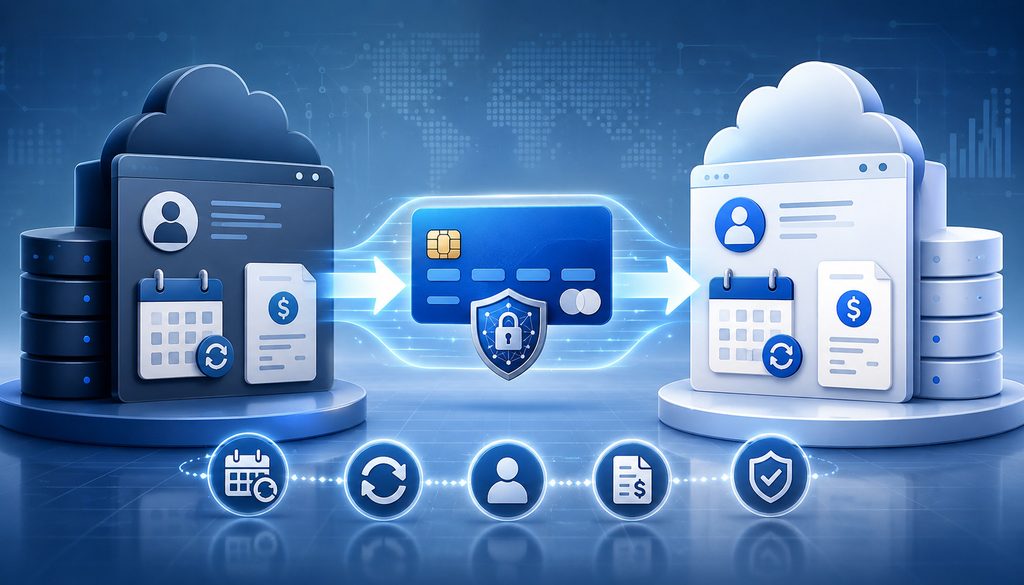
Subscription payment migration fails when a merchant successfully transfers credentials but forgets the billing state attached to them.
A recurring system may need far more than a token:
- customer ID;
- subscription or membership ID;
- plan;
- amount;
- currency;
- billing interval;
- next billing date;
- trial or discount state;
- payment-method token;
- default-payment setting;
- consent or mandate record;
- retry state;
- tax configuration;
- stored-credential metadata;
- account-updater state;
- network-token relationship.
If the merchant changes both the billing platform and processor simultaneously, every one of those objects may need translation.
Subscription Billing Platform vs. Payment Processor
A business can sometimes change the payment processor while leaving the subscription system intact.
For example, the billing platform may continue deciding that customer 123 should be charged $49 on the first day of each month while the gateway routes the payment through a different processor.
That is usually less disruptive than replacing the billing engine, gateway, vault and acquiring relationship at the same time.
If multiple components must change, decouple the work where practical. Migrate the new checkout first, validate new-customer processing, then migrate existing credentials and subscription schedules through a controlled plan.
Stored-Credential Indicators and Transaction References
Recurring and merchant-initiated payments may rely on transaction indicators, stored-credential classifications or prior-transaction references required by the card networks and destination provider.
Do not invent or reconstruct these fields without provider guidance.
Ask the incoming provider whether it needs network transaction IDs, original credential-on-file references, mandate information or previous authorization identifiers. Requirements vary by network, geography, payment scenario and provider integration.
This is particularly important for merchants operating in markets with additional authentication requirements. Some provider migration documentation specifically supports migration of historical network transaction identifiers where relevant.
Customer ID Mapping and the Token Crosswalk
The application’s essential relationship is:
Old Customer ID → Old Token → New Customer ID → New Token
A token crosswalk lets the merchant update application references without exposing PAN.
For example:
| Old Customer ID | Old Payment Reference | New Customer ID | New Token |
| C-10082 | Source token A | NC-78201 | Destination token X |
| C-10083 | Source token B | NC-78202 | Destination token Y |
Official migration workflows commonly return mapping files for this purpose. Stripe, for example, documents post-import mappings that link source processor IDs to newly created destination objects.
Never solve this mapping problem by inserting raw PANs into an ordinary customer database.
Can Customers Keep Their Saved Cards?
Sometimes yes—but only when the merchant’s existing credential architecture and contracts support a secure migration.
Customers are most likely to avoid card re-entry when the merchant can keep the existing gateway/vault or when the old and new providers can perform an approved provider-to-provider credential migration.
Re-entry may still be required when:
- the outgoing provider cannot or will not export eligible credentials;
- the contract gives the merchant insufficient migration rights;
- the destination cannot ingest the source data;
- only nonportable provider tokens exist and no PAN migration is available;
- a wallet credential requires fresh provisioning;
- records are incomplete or invalid;
- customer consent or authentication must be renewed;
- unsupported payment methods are involved.
The key is determining this before the old account is terminated.
When Customer Re-Entry Is Unavoidable
A re-entry campaign should be treated as a fallback, not an improvised emergency.
Identify the specific nonmigrated population and direct those customers to an authenticated payment-update page. Explain that the payment method needs to be refreshed and keep technical details limited to what the customer needs to act safely.
Never request full card numbers or CVV by ordinary email.
A safe workflow is:
- Identify records that cannot be migrated.
- Send the customer to an authenticated account or hosted payment-update page.
- Explain why a secure update is required.
- Confirm when the payment method has been successfully replaced.
- Remove obsolete payment references according to retention requirements.
Forced card re-entry creates friction and may lead to abandoned renewals, so the size of this population should be considered when evaluating the economic value of switching processors.
What Does “Data Ownership” Really Mean?
A contract saying “you own your customer data” does not necessarily guarantee that a processor-specific payment token can be used elsewhere or that a particular credential export is technically available.
Merchants should separate several concepts:
- ownership of the customer relationship;
- access to customer profile information;
- access to transaction history;
- contractual export rights;
- technical credential portability;
- control of the token vault;
- eligibility to receive PANs;
- duration of post-termination access.
A provider may allow export of ordinary customer data while maintaining a separate security process for sensitive payment credentials. Another provider may export eligible PAN data directly to a qualified replacement processor but not to the merchant.
Public migration policies illustrate why these details must be negotiated rather than assumed. Stripe, for example, publishes a process for transferring eligible customer card data directly to an appropriately compliant receiving processor, while also identifying certain credentials that are excluded from those exports.
Processor Contract Clauses to Review
Before changing payment processors, review provisions covering:
- customer and payment-data rights;
- credential export;
- token portability;
- termination;
- transition assistance;
- export or professional-services fees;
- security requirements;
- file format;
- retention periods;
- token-vault access;
- confidentiality;
- legacy portal availability;
- transition service levels.
Contract interpretation should be reviewed with qualified counsel where material obligations, ownership rights or termination risks are involved.
Ask Before You Sign: Payment Processor RFP Questions for Card-on-File Migration
The best time to negotiate a future exit is before entering the relationship.
A payment processor RFP for a business with saved cards should evaluate portability alongside price, authorization performance, integrations and support.
| Question | Why It Matters |
| Who controls the token vault? | Identifies the dependency behind saved-card credentials |
| Can eligible credentials be exported? | Determines whether customers can potentially avoid re-entry |
| Can you import PANs from another provider? | Confirms destination migration capability |
| Can you import existing tokens? | Identifies direct token portability, if any |
| Are network tokens supported? | Determines network-token strategy |
| Can you provide a test migration? | Reduces full-cutover risk |
| Who pays migration fees? | Exposes total switching cost |
| How long is legacy access retained? | Protects refunds, disputes and reconciliation |
| Can old refunds still be processed? | Prevents customer-service surprises |
| How are stored-credential indicators handled? | Supports recurring-payment continuity |
| Is a post-import mapping file provided? | Enables customer/token remapping |
| What is the export process after termination? | Reduces exit risk |
Questions to Ask the Outgoing Processor
Ask in writing:
- Do we have the contractual right to export eligible stored credentials?
- Who owns or controls the vault?
- Is a provider-to-provider PAN export available?
- Which credential types are excluded?
- Which fields are included?
- What customer and payment-method identifiers are preserved?
- What file format is provided?
- What compliance documentation must the destination provide?
- Are export or transition fees charged?
- How long after notice or termination can migration occur?
- Can we keep portal access while refunds and disputes remain open?
- How are historical disputes handled after processing stops?
Questions to Ask the Incoming Processor
Ask whether the destination can:
- accept the outgoing provider’s format;
- securely receive PANs;
- immediately re-tokenize imported credentials;
- preserve or map customer IDs;
- return a token crosswalk;
- handle expired-card records appropriately;
- support network-token provisioning;
- activate account updater;
- handle recurring/MIT relationships;
- migrate in controlled batches;
- perform a sample import;
- validate migration without arbitrary customer charges.
How Long Does a PAN Migration Take Between Processors?
There is no universal PAN migration timeline.
The technical import might be relatively short while the legal, security and coordination work takes substantially longer. The outgoing processor’s responsiveness often matters as much as the size of the dataset.
A realistic planning sequence is:
Contract Review → Data Inventory → Technical Mapping → Provider Security Approval → Test Export → Test Import → Data Validation → Full Migration → Cutover → Post-Migration Monitoring
Factors affecting the schedule include:
- contract and legal review;
- provider migration queues;
- validation of PCI status;
- dataset size;
- number of payment methods;
- encryption or secure-transfer setup;
- field mapping;
- customer-ID quality;
- test migration;
- exception remediation;
- destination tokenization;
- subscription remapping;
- planned billing dates;
- cutover freezes.
Published provider guidance demonstrates that timelines are provider-specific. Stripe notes that a previous processor’s delivery can range from days to weeks and separately documents its own import workflow after receiving usable data. That is an example, not an industry-wide deadline.
For subscription businesses, schedule backward from important renewal cycles. Avoid positioning a major cutover immediately before the highest-volume billing day unless the architecture and rollback plan justify it.
Inventory Your Existing Payment Stack Before Migration
Before choosing the replacement processor, document every system that can create, store, transform or depend on a payment credential.
The inventory should cover:
- acquirers and MIDs;
- processor;
- gateway;
- vault;
- billing platform;
- account updater;
- network-token service;
- fraud platform;
- wallets;
- checkout integrations;
- CRM;
- ERP;
- marketplace systems;
- reporting pipelines.
Then build a credential inventory.
| Payment Credential | Current Owner/Vault | Used For | Expected Migration Method | Main Risk |
| Gateway token | Gateway vault | Ecommerce reorders | Retain gateway or PAN re-tokenization | Token may be gateway-specific |
| Processor token | Processor vault | Subscription billing | Provider-to-provider migration | No direct token portability |
| Network token | Token-service ecosystem | COF ecommerce | Confirm provisioning strategy | Lifecycle relationship may change |
| Wallet credential | Wallet/token service | Mobile checkout | Reconfigure wallet integration | Not ordinary COF token |
| PAN in independent vault | Independent compliant vault | Multiple channels | Retain vault or supported forwarding | Processor connectivity |
Database Migration Without PAN Exposure
Application developers should design the database update around destination references.
Instead of:
customer → PAN
the application’s production state should remain closer to:
customer → destination token
A mapping import can update old token references to new tokens through internal identifiers without placing raw card numbers into application logs, migration tables or general-purpose databases.
Also inspect logging. A temporary migration endpoint that accidentally logs request bodies can expand exposure even when the main application usually handles only tokens.
For related operational security principles, this overview of transaction-security practices provides additional background, while PCI SSC remains the controlling source for PCI DSS requirements.
PCI DSS Responsibilities During Card Migration
A merchant that normally receives only tokens should be particularly cautious about expanding its PCI scope just to make a migration convenient.
The safest general pattern is to let qualified providers handle sensitive credential transfer directly under their approved processes.
Do not:
- email full PAN spreadsheets;
- upload them to ordinary file-sharing accounts;
- manually copy card numbers between interfaces;
- place full PANs in support tickets;
- log full PANs in migration scripts;
- keep temporary PAN exports on employee laptops;
- store migrated PANs in ordinary application databases.
PCI DSS does not prescribe one universal migration method for every provider, but cardholder data must remain appropriately protected, and retention must be limited according to legitimate requirements. PCI SSC also states that sensitive authentication data cannot be retained after authorization.
Never Ask for CVV Migration
CVV is sensitive authentication data and must not be retained after authorization, so there should be no historical CVV database to migrate.
This rule applies even if someone proposes encrypting the CVV. PCI SSC explicitly states that retaining card verification codes after authorization is prohibited.
If a migration export claims to contain historical CVV values, stop and escalate the issue to the appropriate security, compliance and provider teams.
Encryption, Transfer and Data Minimization
Use the transfer mechanisms approved by the source and destination providers.
That may involve encrypted provider-to-provider files or another controlled mechanism defined by their migration teams. Avoid designing an ad hoc transfer scheme simply because it appears technically secure.
The migration dataset should also be minimized. Include the fields legitimately required to preserve the payment relationship and mapping, not every piece of historical customer information simply because it is available.
Test Migration, Validation and Exception Handling
A full card-on-file migration should rarely be the first time the source and destination datasets meet.
Use a controlled test or sample migration where provider processes allow it. The purpose is to confirm assumptions about format, identifiers, token creation and application mapping before the entire customer base depends on the result.
Validate:
- source record counts;
- imported record counts;
- customer mappings;
- token creation;
- expiration values;
- default payment method;
- recurring profile associations;
- duplicate records;
- unsupported payment types;
- migration exceptions;
- reporting outputs.
How to Test Migrated Cards Safely
Do not create arbitrary customer charges merely to verify every stored card.
Ask the destination provider what credential-validation or test process it supports. Testing should distinguish between validating the migration technically and generating a real financial authorization.
Integration testing should also cover new checkout transactions, recurring payments, refunds, webhook events, API retries and reconciliation.
Migration Exceptions
Common exception classes include:
- invalid card data;
- expired credentials;
- unsupported card brands;
- incomplete expiration fields;
- missing customer IDs;
- duplicate source records;
- malformed data;
- unsupported wallet credentials;
- token types the destination cannot ingest.
| Customer/Record | Migration Status | Reason | Next Action |
| Customer 1042 | Migrated | — | Load destination token mapping |
| Customer 1043 | Exception | Missing required mapping field | Correct source mapping |
| Customer 1044 | Re-entry required | Unsupported credential type | Secure customer update campaign |
| Customer 1045 | Review | Expired credential | Check updater/provider workflow |
Never include full PANs in an operational exception report.
Failed records may be addressed through corrected import data, eligible account updater or token lifecycle services, or a customer payment-update campaign.
Cutover Strategy and Preventing Duplicate Charges
Processor migrations typically use either a big-bang cutover or a phased approach.
Big-Bang Cutover
In a big-bang migration, payment traffic moves to the new environment at a defined point.
The advantage is operational clarity: there is one cutover moment and fewer long-lived routing rules.
The disadvantage is concentrated risk. If token mappings, recurring schedules, APIs or settlement reporting are incorrect, a large portion of the customer base can be affected immediately.
Phased Migration
A phased migration moves selected channels, cohorts, regions or customer groups incrementally.
It can reduce blast radius and provide real-world validation before all customers move.
However, it requires strong state management. The business must always know which processor and billing engine owns the next transaction for every active customer.
| Customer Cohort | Old Processor Active? | New Processor Active? | Next Billing Owner |
| Migrated subscriptions | No for new renewals | Yes | New billing environment |
| Pending credential migration | Yes | No | Legacy billing environment |
| New customers | No | Yes | New environment |
| Legacy refund-only cohort | Refunds only | New sales only | Depends on original transaction |
Dual-Processor Period
Temporary overlap can be valuable for:
- legacy refunds;
- controlled recurring migration;
- rollback;
- dispute handling;
- settlement reconciliation.
But dual processing creates a serious hazard: duplicate charges.
Maintain one authoritative billing owner for each customer and billing period.
Use transaction state, cohort assignment and API idempotency controls so retries do not unintentionally produce multiple authorizations or captures. Idempotency is especially important when migration scripts or billing workers retry after network failures and cannot immediately determine whether the first request succeeded.
Pre-Cutover Checklist
Before switching production routing, confirm:
- credentials migrated;
- token crosswalk loaded;
- recurring schedules mapped;
- webhook endpoints updated;
- live API credentials installed;
- fraud controls configured;
- account updater configured;
- network-token strategy confirmed;
- refunds tested;
- settlement reports tested;
- customer support briefed;
- rollback responsibilities assigned.
Freeze nonessential payment configuration changes around the cutover so unrelated deployments do not complicate troubleshooting.
Gateway and API Migration
Switching gateways can be more disruptive than changing the acquiring connection beneath an existing gateway.
A gateway migration can affect:
- token formats;
- hosted payment pages;
- SDKs;
- API endpoints;
- authentication;
- authorization/capture behavior;
- webhooks;
- refund APIs;
- error codes;
- fraud tools;
- 3-D Secure flows;
- recurring billing.
Switch Gateways Without Losing Saved Customer Cards
Success depends heavily on vault ownership.
If the existing gateway owns the vault and its tokens cannot operate elsewhere, the merchant may need a PAN export and destination re-tokenization process.
If an independent vault is used, the gateway can potentially change while the vault remains stable, provided the destination connectivity and security model support the arrangement.
This distinction is one of the most important questions to ask while selecting payment technology. A broader merchant-services evaluation should therefore include security, integration, recurring billing and contractual flexibility rather than rates alone; this merchant-services feature guide provides additional context.
Webhooks and Payment State
Gateway migration also requires a webhook plan.
Update:
- endpoint signing secrets;
- event schemas;
- transaction identifiers;
- retry behavior;
- payment-status mappings;
- subscription events;
- dispute and refund events.
Do not rely solely on the customer’s browser redirect to determine final payment state. Server-to-server event handling and processor queries should follow the destination provider’s recommended integration model.
Fraud Controls
Authorization rates can change after migration because the new environment may handle AVS, device information, 3-D Secure, risk scores and velocity controls differently.
Do not disable fraud controls simply to raise early migration approval numbers.
Instead, compare decline reasons and risk decisions, then tune the new environment using legitimate customer behavior and provider guidance.
Monitoring Authorization and Recurring-Payment Performance
A successfully imported credential can still fail later.
The underlying account may have expired, been closed or replaced. The issuer may decline the transaction. Stored-credential metadata may be wrong. Account updater may not be configured. A network-token lifecycle relationship may have changed.
Monitor the migration as a payment-performance event rather than declaring success after the import file is accepted.
Track:
- migrated-credential authorization rate;
- recurring renewal success;
- failed payments;
- decline categories;
- customer payment updates;
- updater results;
- network-token status where applicable;
- refund success;
- support contacts.
| Metric | Before Migration | After Migration | Variance |
| Authorization rate | Baseline | Measure | Compare |
| Recurring renewal success | Baseline | Measure | Compare |
| Failed payments | Baseline | Measure | Compare |
| Customer payment updates | Baseline | Measure | Compare |
| Refund success | Baseline | Measure | Compare |
| Support contacts | Baseline | Measure | Compare |
Do not use arbitrary industry approval-rate targets. Compare the merchant against its own baseline while controlling for traffic mix, issuer behavior, seasonality and customer cohorts.
Recurring Payment Retry Logic
A declined recurring transaction should not be retried indefinitely.
Use your processor’s network-aligned retry and decline guidance, distinguish recoverable situations from hard declines where supported, and combine appropriate retries with customer communication and dunning.
Updater services may help when the credential changed, but they do not guarantee that every failed payment becomes recoverable.
Refunds, Chargebacks and Legacy MID Access After Migration
Stopping new sales on the old processor does not mean the old environment immediately becomes irrelevant.
Refunds and disputes can involve transactions processed before cutover, sometimes long after the merchant has begun routing new payments elsewhere.
A new processor usually should not be assumed to have the context or transaction identifiers required to refund a transaction processed through the previous environment.
Refund Continuity
Before closing the old account, determine:
- whether refunds must continue through the legacy processor;
- how long transaction history remains accessible;
- which legacy identifiers must be retained;
- whether portal or API credentials stay active;
- what happens if a refund is requested after account termination;
- how refund settlements appear in bank reconciliation.
Do not invent a universal legacy refund window. It depends on provider rules, contracts, transaction timing and card-network requirements.
Chargebacks After Migration
Disputes may arrive for transactions created before the processor switch.
Preserve:
- legacy transaction records;
- order records;
- authorization identifiers;
- proof of fulfillment;
- customer communications;
- statements;
- dispute portal access;
- old MID information.
A merchant that prematurely deactivates access can make dispute response unnecessarily difficult even when new payments are functioning perfectly.
Legacy MID and Settlement Reconciliation
During overlap, finance may need to reconcile:
Old Processor Settlements + New Processor Settlements → Bank → General Ledger
A useful reconciliation table is:
| Date | Processor | Transactions | Gross | Refunds | Fees | Net Deposit |
| Cutover day | Legacy | Reconcile | Reconcile | Reconcile | Reconcile | Reconcile |
| Cutover day | New | Reconcile | Reconcile | Reconcile | Reconcile | Reconcile |
Also reconcile credential counts:
Eligible Source Credentials → Successfully Migrated → Exceptions → Customer Re-Entry Required
At minimum, compare source customers, source payment methods, imported records, tokenized records, failures and duplicates.
Multi-MID, Multi-Entity and International Migrations
Large merchants need additional mapping controls because payment credentials may be associated with different legal entities, merchant accounts, brands, locations or channels.
Do not simply migrate every saved credential into one destination account.
For each record, identify the appropriate:
- legal merchant entity;
- acquiring relationship;
- MID;
- brand;
- business unit;
- location;
- ecommerce channel;
- currency environment.
Credential-sharing rules and token configurations can depend on how the original payment relationship was established and how the destination is structured.
International merchants may also face regional vaults, local acquiring arrangements, currency differences, country-specific authentication requirements, card-brand coverage and data-transfer restrictions.
These issues are highly architecture-specific, so involve the processors, legal/privacy teams and security specialists rather than assuming a U.S.-style domestic migration workflow applies everywhere.
Processor Pricing Is Not the Only Decision Factor
A lower quoted processing rate can become an expensive deal if changing payment processors forces thousands of customers through card re-entry.
Evaluate total migration economics, not just basis points.
A useful framework is:
Migration Cost = Technical Work + Provider Fees + Customer Update Effort + Failed Renewals + Support + Parallel Processing + Reconciliation
Potential expenses include:
- termination fees;
- credential export fees;
- professional-services charges;
- re-tokenization work;
- engineering;
- customer support;
- parallel processing;
- legacy portal charges;
- additional reconciliation;
- involuntary churn.
A provider offering slightly lower processing cost may be less attractive if its vault architecture creates severe future lock-in.
Vendor Lock-In and Portability
Tokenization is primarily a security architecture, but private vault tokens can create commercial switching costs.
That does not make private tokenization undesirable. It means merchants should understand the exit path before committing significant recurring revenue to the environment.
Portability should therefore become an RFP requirement alongside authorization, availability, security, reporting and pricing.
Contract Language to Negotiate
At a high level, seek clarity regarding:
- export of eligible credentials;
- post-termination timing;
- supported format;
- direct transfer to qualified providers;
- migration assistance;
- fees;
- data retention;
- token portability;
- transition support;
- continued refund/dispute access.
Actual contractual wording should be reviewed by qualified legal counsel familiar with the merchant’s business and payment arrangements.
Never Sign Before You Know These Answers
Before signing a payment processor contract involving substantial card-on-file volume, know the answers to these questions:
- Who controls the vault?
Identify whether it belongs to the processor, gateway, independent provider or another platform. - Can eligible stored PANs be exported?
Ask for the exact process and restrictions. - Are the tokens themselves portable?
Do not confuse token export with PAN migration. - Can another PCI-compliant provider receive credentials directly?
Provider-to-provider transfer should be the expected model where PAN migration is used. - What happens to network tokens?
Determine whether they remain, transfer, map or require new provisioning. - What happens to account updater services?
Confirm whether destination enrollment is necessary. - What does migration cost?
Obtain fees before signing. - What is the provider’s migration process and service commitment?
Avoid promises with no defined process. - How long is legacy access available?
Refunds and disputes may outlive new payment processing. - Can an export or sample migration be tested before termination?
Testing reduces surprises. - How are old refunds and chargebacks handled?
Document the operating model. - Are customer IDs and payment-method identifiers included?
Without mapping data, usable credentials can still become orphaned.
Processor Migration RFP Scorecard
A scorecard turns portability into a comparable procurement requirement.
| Requirement | Provider A | Provider B | Provider C |
| PAN import | Verify | Verify | Verify |
| Token import | Verify | Verify | Verify |
| Network-token support | Verify | Verify | Verify |
| Account updater | Verify | Verify | Verify |
| Test migration | Verify | Verify | Verify |
| Mapping/crosswalk file | Verify | Verify | Verify |
| Legacy refund support | Verify | Verify | Verify |
| Migration service commitment | Verify | Verify | Verify |
| Export rights | Verify | Verify | Verify |
| Post-termination assistance | Verify | Verify | Verify |
Avoid scoring “yes” based only on a salesperson saying, “We support tokenization.” Ask exactly which credential types can be imported and exported, under what conditions, and through which security process.
Common Processor Migration Mistakes
Most costly migration failures are preventable.
Common mistakes include:
- assuming every token is portable;
- signing the new agreement before confirming source export rights;
- terminating the old account before credential migration finishes;
- asking the old provider to email a PAN file;
- trying to migrate CVV;
- changing gateway, processor and billing platform simultaneously without dependency planning;
- losing stored-credential metadata;
- failing to preserve customer/token mapping;
- skipping a test migration;
- allowing two billing engines to charge the same subscription;
- ignoring account updater;
- assuming network tokens migrate automatically;
- losing old refund or dispute access;
- focusing only on processing rates;
- failing to negotiate exit assistance.
The most dangerous shortcuts usually arise late in the project, when the business is under pressure to meet a termination or renewal date.
Planning portability before contract signature is substantially easier than solving it after a provider relationship has deteriorated.
Processor Migration Checklist
Use this checklist before authorizing the production cutover.
| Area | Verified? |
| Current vault owner | Yes / No |
| Credential types identified | Yes / No |
| Contractual export rights | Yes / No |
| Incoming import capability | Yes / No |
| Provider-approved PCI transfer process | Yes / No |
| PAN/token migration approach | Yes / No |
| Network-token treatment | Yes / No |
| Account updater configuration | Yes / No |
| Recurring/MIT metadata | Yes / No |
| Customer ID mapping | Yes / No |
| Token crosswalk | Yes / No |
| Test migration | Yes / No |
| Exception workflow | Yes / No |
| Customer re-entry fallback | Yes / No |
| Cutover plan | Yes / No |
| Idempotency controls | Yes / No |
| Duplicate-charge prevention | Yes / No |
| Refund continuity | Yes / No |
| Chargeback continuity | Yes / No |
| Legacy reporting access | Yes / No |
| Settlement reconciliation | Yes / No |
| Customer communication | Yes / No |
A processor switch is ready when the business can explain not only how new payments will work, but also what happens to every meaningful legacy payment relationship.
Frequently Asked Questions
Can I switch payment processors without making customers re-enter their cards?
Yes, sometimes. Customers may be able to keep their saved payment methods when the existing gateway or vault remains in place or when the outgoing and incoming providers support a secure card-on-file migration.
The determining factors are vault ownership, credential type, contractual export rights, incoming-provider import capability and the available security process.
Processor-specific tokens frequently cannot simply be copied to another processor because they reference a private vault. If eligible PANs can be securely transferred provider-to-provider and re-tokenized, customer re-entry may be avoided for many records.
What is PAN migration?
PAN migration is the controlled transfer of eligible underlying primary account numbers and associated permitted card information from one PCI-compliant payment environment to another.
The receiving provider can then tokenize those credentials in its own vault and return new customer or payment-method references.
PAN migration should not mean a merchant downloading card-number spreadsheets and manually uploading them elsewhere. Provider-to-provider migration processes are designed to keep sensitive credentials within appropriately controlled environments.
What is payment token migration?
Payment token migration can mean either transferring usable token references where both environments support them or replacing old token references with newly created destination tokens after a PAN migration.
These are different processes. Many ordinary processor tokens are merely references into the source provider’s vault and have no meaning at another provider. In those cases, the underlying eligible credential may need to be transferred securely and re-tokenized rather than moving the original token string.
Are payment processor tokens portable?
Not necessarily.
A processor token often represents a lookup key into that processor’s proprietary vault. The token can be valuable precisely because the merchant cannot derive the underlying PAN from it, but that also means another processor usually cannot interpret it without a supported interoperability or migration process.
Always ask whether “token portability” means the original token remains usable, the provider exports the underlying eligible PAN securely, or the provider supplies a token mapping after migration.
What is the difference between a processor token and a network token?
A processor token is generally created and controlled inside a provider’s private vault architecture.
A network token is created through payment-network tokenization infrastructure and can include domain restrictions, provisioning relationships and lifecycle-management capabilities. EMVCo’s tokenization framework describes payment tokens that may be constrained to specific merchants, devices or use cases.
Neither should be assumed automatically portable between every acquiring or processing environment.
Can a gateway token work with a new processor?
Sometimes.
If the merchant keeps the same gateway and token vault and the gateway supports routing transactions to the new processor, existing tokens may remain usable. That can make changing the downstream processor considerably easier.
If the gateway also changes, however, the source gateway token may no longer have meaning. The merchant may need a provider-to-provider credential export and re-tokenization into the destination vault.
How long does a PAN migration take between processors?
There is no universal timeline.
Duration depends on contractual review, provider responsiveness, PCI validation, file preparation, field mapping, dataset size, secure-transfer arrangements, test imports, exception remediation, tokenization and cutover planning.
Plan the migration around actual provider commitments rather than an assumed industry average, and leave room for troubleshooting before terminating the legacy environment.
Can my old processor refuse to export saved card data?
Possibly, depending on the credential architecture, contract, applicable requirements and provider policies.
A statement that the merchant “owns its data” does not automatically guarantee that every token can be exported or that every credential is eligible for migration.
Before signing any processing agreement, determine what can be exported, to whom it can be sent, what fees apply, how long assistance remains available after termination and whether any credential types are excluded.
Is CVV included in a card-on-file migration?
No. Historical CVV should not exist in the migration dataset.
PCI SSC states that card verification codes are sensitive authentication data and cannot be retained after authorization, including for recurring and card-on-file transactions.
A customer may enter a CVV during a new transaction where appropriate, but merchants should never attempt to preserve, export or migrate historical CVV values.
How do recurring subscriptions continue after a processor change?
The payment credential is only one part of the subscription.
The merchant must also preserve or remap customer IDs, plans, amounts, currencies, billing intervals, next billing dates, default payment methods, consent records, retry state, tax settings and applicable stored-credential metadata.
If the recurring-billing platform stays in place while only the processor changes, migration may be simpler. Replacing the processor and billing engine together requires much more extensive mapping and testing.
What happens to account updater services after migration?
Do not assume the old updater relationship automatically follows the credential.
Determine whether the incoming processor or gateway requires separate account-updater enrollment and how existing credentials will participate after migration. Services such as Visa Account Updater support eligible updates to stored account information for participating merchants and acquirers, but participation and technical implementation matter.
Include updater activation in the cutover checklist.
How should migrated payment credentials be tested?
Start with record and mapping validation, then use the destination provider’s approved migration-validation and payment-testing processes.
Do not place arbitrary real charges on every customer merely to see whether the cards work.
Test the end-to-end system as well: customer mapping, subscription billing, API behavior, webhooks, refunds, idempotency, settlement reporting, account updater and exception workflows.
Can the new processor refund transactions processed by the old processor?
Do not assume it can.
Refunds often depend on the original transaction identifiers and processing environment. Merchants should preserve legacy processor access and determine how old transactions will be refunded before terminating the account.
The same principle applies to disputes, reporting and settlement reconciliation. Legacy operational access may need to remain available even after all new sales route through the replacement processor.
What questions should I ask before signing a payment processor contract?
At minimum, ask who controls the vault, whether eligible PANs can be exported, whether tokens are portable, whether exports can go directly to another PCI-compliant provider, how network tokens and account updater are handled, what migration costs, what formats are supported and how long post-termination access lasts.
Also ask about test migrations, customer-ID mappings, refunds, disputes and migration service commitments.
These answers can matter as much as processing price for a business with substantial recurring or saved-card volume.
What should a payment processor RFP include for card-on-file portability?
Include explicit requirements for PAN import/export, token import or mapping, destination tokenization, network-token support, account updater, test migration, customer-ID preservation, token crosswalks, legacy refund support, dispute continuity, post-termination assistance and security processes.
Request written descriptions rather than simple yes/no responses.
A strong RFP evaluates both how the merchant enters the provider’s ecosystem and how it can leave it.
Conclusion
Switching processors without losing card-on-file customers is possible in many payment architectures, but it is never something a merchant should assume.
Start by identifying what each saved credential really is. A PAN held in a compliant vault, processor token, gateway token, merchant-controlled reference, network token and wallet credential are not interchangeable.
Then establish who controls the vault, what the contract permits, what the outgoing provider can securely export and what the incoming provider can actually import.
For many migrations, the cleanest path is a provider-to-provider PAN transfer followed by destination re-tokenization and a customer/token crosswalk. For others, retaining an existing gateway or independent vault avoids credential movement altogether. Some credentials will still require customer re-entry.
The full migration must also preserve subscription state, stored-credential processing, customer IDs, network-token dependencies, account updater, refunds, disputes and reconciliation.
Most importantly, negotiate portability before signing.
The best processor agreement is not merely one that can accept payments efficiently today. For a merchant with recurring or saved-payment customers, it should also provide a clearly understood path for securely moving those customer relationships tomorrow.
Informational notice: Payment-security, card-network and contractual requirements depend on the merchant’s architecture, providers, geography and business model. Coordinate card-on-file migrations with the relevant PCI-compliant payment providers and obtain qualified security, PCI, legal and privacy guidance where appropriate.