
By Charles West October 9, 2026
To add ecommerce to existing merchant account processing, you must first confirm that your payment processor approves online card-not-present transactions. Your existing retail MID may support ecommerce after additional underwriting and configuration, or the processor may require a separate ecommerce MID. Do not activate online payments until the new channel is authorized.
A retail store may already accept credit and debit cards without difficulty. But launching an online checkout introduces a different type of payment activity.
Your existing merchant account was approved based on information about your business, including where customers pay, what you sell, and how transactions are completed.
Moving from in-person sales to ecommerce can change those assumptions.
The good news is that selling online does not necessarily mean changing processors or opening an entirely new merchant relationship. Many payment providers support both physical-store and ecommerce transactions.
The question is whether your existing account has been approved and configured for that additional channel.
Understanding card-present vs card-not-present account approval can help you avoid transaction declines, unnecessary account reviews, payment security problems, and confusion over deposits.
Can You Add Ecommerce to an Existing Merchant Account?
Yes. In many cases, a retail merchant can expand an existing processing relationship to accept ecommerce payments.
However, an account approved for card-present transactions does not automatically authorize every type of card-not-present payment.
The processor or acquiring institution needs to confirm that the proposed online activity fits the account’s underwriting and technical configuration.
Generally, there are three possible outcomes.
| Processor decision | What it means | Merchant’s next step |
| Approve ecommerce on existing MID | Current MID can support the new channel after appropriate configuration | Configure and test the gateway |
| Issue a separate ecommerce MID | Online sales will use a distinct merchant processing profile | Complete any additional setup |
| Request further review | More business or operational information is needed | Submit requested documentation |
A separate MID is not universally required for every retailer opening a website.
The processor decides the appropriate structure based on its acquiring arrangements, platform capabilities, merchant agreement, and the business’s risk characteristics.
Key distinction: A payment gateway makes online checkout technically possible. Processor approval establishes whether the merchant is authorized to use that payment channel.
Both must be addressed before launch.
Why Card-Present vs. Card-Not-Present Account Approval Matters
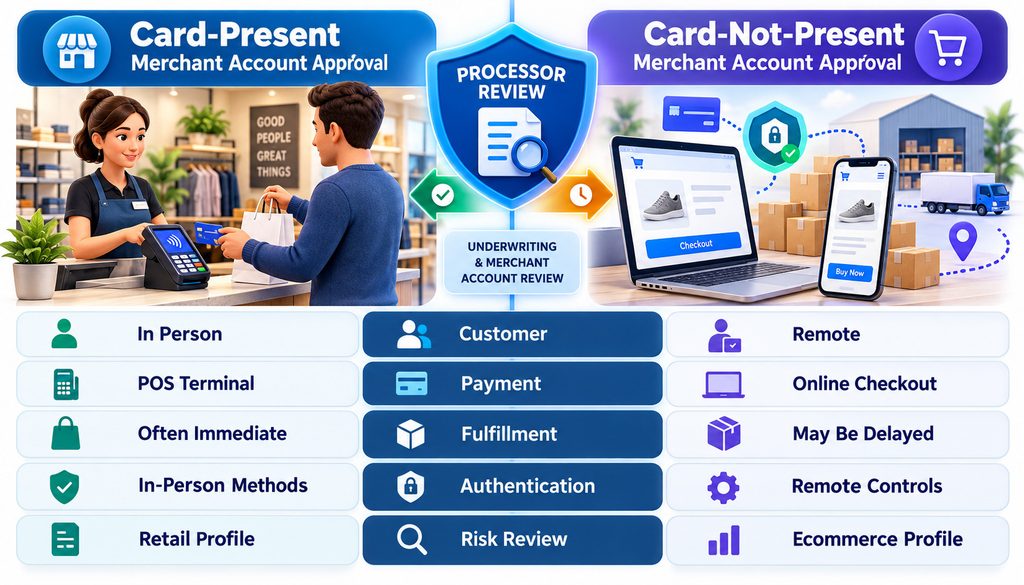
Card-present and card-not-present transactions differ primarily in the payment acceptance environment.
In a typical card-present retail transaction, a customer physically presents a card or compatible payment device at a supported terminal.
With ecommerce, the purchase takes place remotely through a website or application.
That difference affects transaction authentication, fraud screening, fulfillment exposure, and potentially processing costs.
Visa’s Core Rules and Product and Service Rules distinguish card-present and card-absent transaction environments. Mastercard’s transaction-processing standards also establish requirements for ecommerce acceptance.
Why Retail Accounts May Have Different Underwriting Assumptions
Consider a hardware store where customers pay at checkout and leave with their purchases.
The merchant’s existing processing history may reflect immediate delivery, familiar purchasing patterns, and in-person payment acceptance.
Now imagine the same store begins selling equipment through its website.
Customers may order from other states, use remote payment credentials, and receive merchandise several days after payment.
The processor may need to review the additional exposure associated with shipping, refunds, unauthorized transactions, and customer disputes.
This does not make every ecommerce merchant high-risk. It means the processor needs accurate information about the new sales process.
What Changes When You Add Online Sales?
| Risk factor | Card-present retail | Ecommerce |
| Customer interaction | Usually in person | Remote |
| Card acceptance | Terminal-based | Website or app checkout |
| Authentication | Supported in-person methods | Supported remote authentication and fraud controls |
| Fulfillment | Often immediate | May occur after payment |
| Disputes | Product, authorization, service and other disputes | Additional delivery-related exposure may arise |
| Security environment | POS and terminal systems | Website, gateway, scripts and connected services |
The merchant account must reflect the actual payment activity.
A business should not assume that successful in-store processing automatically means its online transactions are approved.
How to Add Ecommerce to Existing Merchant Account Processing
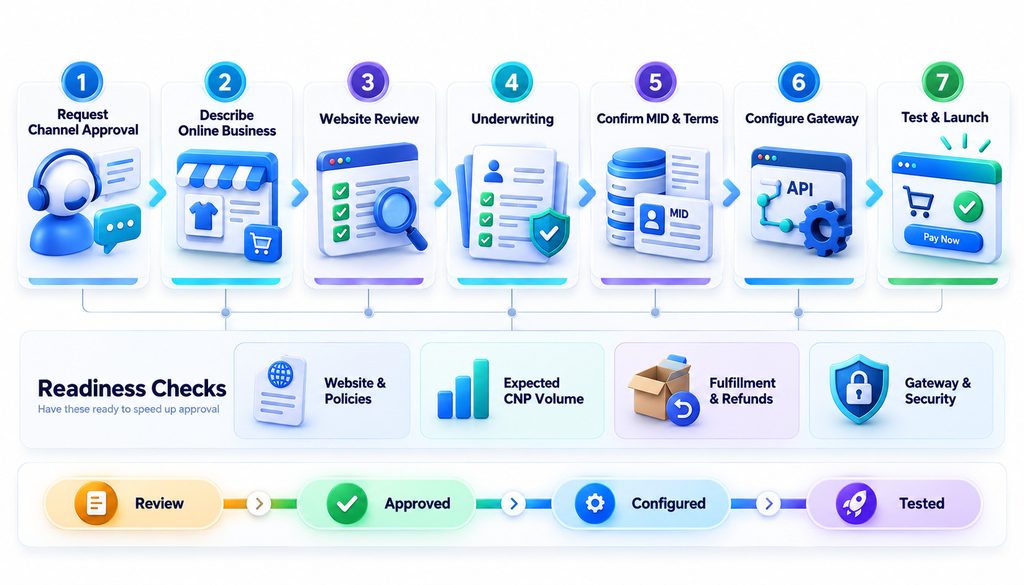
The best approach is to request a channel expansion before enabling live online payments.
For most retailers, this process begins with their current processor rather than a new provider.
Step 1: Request Processor Channel Approval
Contact your payment provider and explain that you plan to begin accepting payments through a website.
Ask whether internet ecommerce transactions are already authorized under your merchant agreement.
If not, request the process for adding that channel.
Confirm whether the processor can enable ecommerce on the existing MID or requires a separate processing profile.
Step 2: Describe the Online Business
Provide an accurate explanation of what your website will sell.
If the products match your retail inventory, mention that. If the website introduces preorders, custom merchandise, subscriptions, or longer fulfillment times, explain those differences.
Also disclose the expected online transaction volume and the approximate percentage of total sales that will come from ecommerce.
Step 3: Prepare Your Website for Review
The processor may examine your website before approving live transactions.
Customers should be able to identify the merchant, understand the products, and find relevant fulfillment and refund information.
A functioning storefront with transparent policies is easier to evaluate than an incomplete website.
Step 4: Complete Any Additional Underwriting
The processor may request business records, website information, projected transaction amounts, or fulfillment details.
An established processing history can help explain the business, but it does not guarantee automatic channel approval.
Step 5: Confirm MID Assignment and Processing Terms
Request written confirmation of whether ecommerce will use your current MID or a separate ecommerce MID.
Review any changes to pricing, transaction limits, settlement arrangements, or reserve conditions.
Step 6: Configure the Payment Gateway
Connect the approved processing arrangement to the online checkout.
Depending on the provider, this may involve a hosted checkout, an ecommerce plugin, or an API integration.
Step 7: Test Before Launch
Test successful purchases, declined payments, refunds, order updates, and transaction reporting.
Only begin live processing after the relevant approval and technical configuration have been confirmed.
Following this sequence makes it easier to add ecommerce to existing merchant account processing without introducing unexplained card-not-present activity.
What Does the Ecommerce Underwriting Review Require?
An ecommerce review helps the processor understand the business behind the website.
Merchants should prepare the relevant information before submitting a channel expansion request.
| Underwriting item | Information to provide |
| Website | Functional URL and representative product pages |
| Business identity | Legal business name, DBA and contact details |
| Products or services | Accurate descriptions and pricing |
| Expected ecommerce volume | Realistic monthly processing estimate |
| Average and maximum ticket | Expected transaction sizes |
| Fulfillment | Shipping method and delivery timeframe |
| Refunds and cancellations | Clear customer-facing policies |
| Customer geography | Domestic or international sales |
| Sales channel mix | Projected online versus in-store volume |
| Payment configuration | Proposed gateway and checkout method |
These are common review categories rather than a universal application checklist.
A provider may request more or less information based on the business.
Why Fulfillment Time Is Important
A retailer shipping available inventory within two business days presents different fulfillment characteristics from one accepting payment for custom merchandise that will ship in eight weeks.
Both businesses may be legitimate.
However, longer delivery periods can introduce additional exposure if customers cancel orders, deliveries are delayed, or the merchant cannot fulfill purchases.
The processor may therefore examine the business’s fulfillment process and refund obligations.
Why Your Expected Online Sales Mix Matters
Suppose a retail merchant currently processes $60,000 per month in-store and expects $20,000 in additional online sales.
The projected combined monthly card volume would be $80,000, with ecommerce representing 25%.
That estimate tells the processor how materially the business’s processing activity will change.
The figures are illustrative, not a regulatory reporting threshold.
Merchants should provide realistic forecasts and update their processor when the approved business profile changes materially.
Existing MID or Separate MID for Ecommerce: Which Is Better?
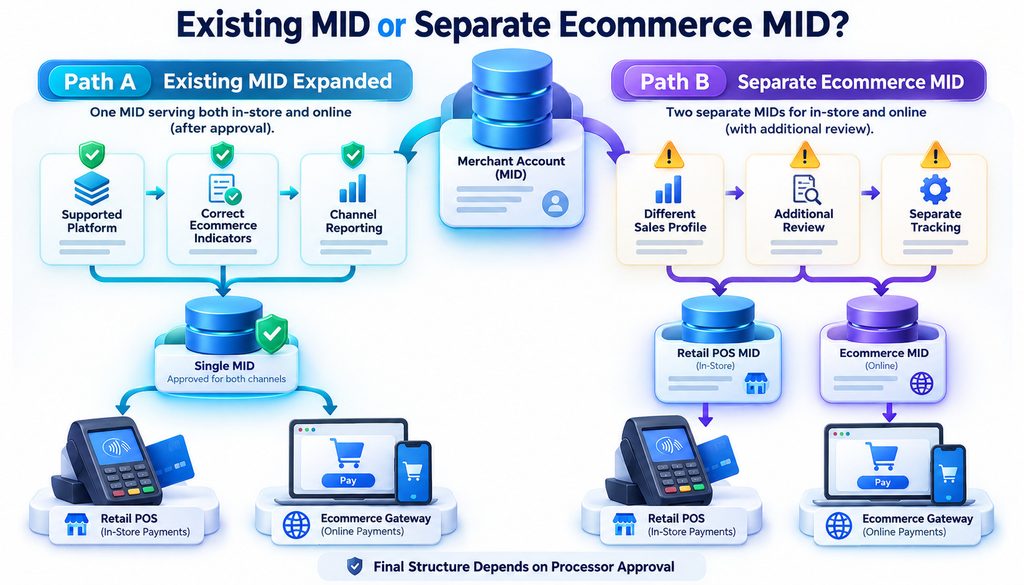
A merchant identification number helps identify a processing arrangement within the acquiring environment.
An existing MID may support more than one approved channel, depending on the platform and processor.
Other arrangements use separate MIDs to distinguish ecommerce from retail activity.
The correct MID for ecommerce channel processing depends on the merchant’s actual operating requirements.
When the Existing MID May Be Suitable
An existing-MID expansion may work when the same legal business sells similar products through its website and retail location.
The processor must still support appropriate ecommerce transaction indicators, gateway connectivity, and reporting.
Using one MID does not make remote transactions card-present.
When a Separate Ecommerce MID May Help
A separate MID may be more useful when online sales involve different fulfillment timelines, products, payment arrangements, or risk characteristics.
It may also help merchants that need clearer separation of settlement activity or channel-specific performance.
| Factor | Existing MID with ecommerce enabled | Separate ecommerce MID |
| Processor approval | Required as applicable | Required |
| Additional review | Depends on merchant activity | May be required |
| Technical setup | Ecommerce configuration added | Separate processing configuration |
| Reporting | Requires reliable channel identification | MID-level identification may be simpler |
| Pricing | May have revised terms | May have distinct terms |
| Funding | Depends on provider setup | Depends on provider setup |
| Administrative work | May be less complex | May involve additional management |
Neither option is automatically less expensive or more compliant in every case.
A useful question for the processor is:
“Can you support our ecommerce channel on the existing MID while preserving correct transaction classification and separate retail-versus-online reporting?”
This addresses the practical requirements rather than focusing only on the MID count.
Gateway Provisioning: What Must Be Added to Accept Online Payments?
After processor channel approval, the merchant needs a supported technical connection between its website and the payment processing environment.
This is usually handled through an ecommerce payment gateway.
The gateway collects or securely facilitates payment information, routes transaction requests, and communicates payment results to the online store.
A processor and a gateway perform different functions, as explained in payment gateways versus payment processors.
What Does Gateway Setup Typically Include?
| Component | Purpose |
| Approved processing profile | Associates ecommerce activity with an authorized merchant arrangement |
| Gateway account | Connects the website with supported payment services |
| Plugin or API credentials | Enables checkout integration |
| Hosted payment page or fields | Facilitates secure payment collection |
| Fraud controls | Helps identify suspicious transactions |
| Refund functionality | Supports appropriate transaction returns |
| Settlement reporting | Helps reconcile approved, settled and refunded transactions |
The processor or gateway provider should explain which components it manages and which are the merchant’s responsibility.
How Long Does Processor Channel Approval Take?
There is no universal approval timeline.
A straightforward expansion involving an established retailer and a supported ecommerce platform may require less work than an application involving unfamiliar products, long fulfillment times, or additional verification.
For planning purposes, divide the process into four stages:
- Website and underwriting documentation review.
- Ecommerce channel and MID decision.
- Gateway configuration and integration.
- Testing and authorization for production processing.
Some stages may overlap.
Rather than relying on an assumed three-day or seven-day setup promise, ask your provider for a timeline based on your actual application.
Businesses comparing technical requirements can also review payment technology integration considerations, particularly how payment systems connect with retail and ecommerce software.
What Happens If You Start Selling Online Without Processor Approval?
Launching a website does not automatically create a processing violation. Problems arise when the merchant processes transactions outside the activities authorized under its agreement or uses an unsupported configuration.
If previously undisclosed card-not-present volume appears, the processor may investigate whether the business has changed its sales model.
Possible consequences include transaction declines, requests for additional documentation, account reviews, or changes to risk controls under the applicable agreement.
In serious cases, restrictions or termination may be possible.
None of these consequences should be described as an automatic penalty for every merchant adding online sales.
The risk depends on what was originally approved, what the new transactions represent, and how the provider responds.
The simplest preventive measure is to obtain written processor channel approval before activating the ecommerce checkout.
How Ecommerce May Affect Pricing, Reserves and Deposit Timing
When merchants add online sales channel merchant account capabilities, they should review the financial terms alongside the technical setup.
Online transactions may carry different underlying costs and introduce new operational considerations.
Processing Rates and Gateway Fees
Card-not-present transactions can receive different network pricing treatment from eligible card-present transactions.
The final merchant cost depends on the payment characteristics, card type, processor pricing agreement, gateway services, and other applicable charges.
Ask the provider for a written breakdown covering ecommerce processing rates, per-transaction fees, gateway charges, and any additional services.
Do not assume a fixed card-not-present surcharge applies to every payment.
Reserves and Transaction Limits
A processor may consider reserves or transaction limits when assessing exposure between payment and fulfillment.
These controls are not automatic requirements for opening an ecommerce store.
Whether they apply depends on the merchant agreement and underwriting outcome.
Before launching, ask whether the approved ecommerce channel has different volume limits, ticket limits, reserve provisions, or review conditions.
Deposit Timing
An ecommerce channel does not necessarily change settlement timing.
Some providers may fund both retail and online transactions through the same arrangement. Others may use different settlement or reporting configurations.
Confirm how deposits, refunds, fees, adjustments, and any reserves will appear on your statements.
The reader does not need an invented industry-average reserve percentage or approval timetable. A clear list of contract terms to verify is more useful.
Why Keying Online Orders Into a Retail Terminal Is the Wrong Shortcut
A retailer may consider collecting orders through a website and manually entering card details into an existing physical terminal.
This can seem easier than setting up a gateway, but it does not solve the approval problem.
Manually entering a remote payment does not make the transaction card-present.
Certain terminals and virtual terminals support authorized keyed or mail-order/telephone-order transactions. However, permission to use those methods does not automatically authorize internet ecommerce activity.
Mastercard’s Transaction Processing Rules distinguish ecommerce and other card-not-present transaction environments. Merchants and acquirers must handle the transactions using the appropriate requirements and information.
What Can Go Wrong?
Manual entry may create unnecessary work, transaction-classification problems, and difficulty connecting payments to online orders.
Collecting card details through ordinary email messages, unsecured website forms, or spreadsheets can also expand exposure to sensitive payment information.
The correct solution is an authorized online payment method with appropriate checkout security and transaction reporting.
If the processor offers payment links or a virtual terminal, confirm which transaction types and sales activities those tools are approved to support.
Do not treat them as automatic substitutes for ecommerce channel approval.
PCI DSS and Fraud Screening for an Ecommerce Checkout
Selling online with retail merchant account credentials does not mean the physical store’s existing PCI validation automatically covers the website.
The applicable security responsibilities depend on how payment information is collected, transmitted, processed, and stored.
For example, a merchant using a third-party hosted payment page may have a different cardholder-data environment from one operating its own payment form.
However, a hosted or embedded integration does not guarantee eligibility for a particular PCI Self-Assessment Questionnaire.
The PCI Security Standards Council’s official SAQ A eligibility clarification explains the script-security criterion relevant to embedded third-party payment forms and distinguishes those arrangements from redirect-based checkout.
Merchants should confirm their actual PCI assessment and validation requirements with the acquirer or other entity managing their compliance program.
Practical Fraud Controls
A new ecommerce checkout should be evaluated for supported security measures, including address verification, card security code checks, transaction velocity rules, and appropriate authentication options.
Not every merchant needs identical fraud settings.
A store selling inexpensive household merchandise may require a different configuration from one accepting large orders for high-value electronics.
For related practices, see transaction security best practices.
The objective is to reduce fraud exposure without unnecessarily rejecting legitimate customers.
Keep Retail and Ecommerce Reporting Separate
Channel-level reporting matters even when both sales channels use one approved MID.
A retailer needs to identify which transactions originated in-store and which came from the website.
Without that distinction, reconciling deposits, processing fees, refunds, and disputes becomes more difficult.
Example: Daily Channel Reconciliation
Suppose a business records the following card activity:
| Transaction category | Retail | Ecommerce |
| Gross sales | $6,000 | $2,000 |
| Refunds | $100 | $50 |
| Sales less refunds | $5,900 | $1,950 |
The combined amount before other adjustments is $7,850.
That does not necessarily equal the bank deposit because settlement dates, fees, disputes, reserves, and other adjustments may differ.
A proper reconciliation matches the POS and ecommerce records to processor settlement records and then to actual funding.
The same reporting should allow the merchant to identify disputes by channel.
This can help determine whether online complaints relate to fulfillment, fraud, or refund communication rather than the in-store sales process.
When evaluating providers, the available reporting and integration features are worth comparing alongside pricing. The article on merchant services provider features covers several of these operational considerations.
Ecommerce Merchant Account Approval Checklist
Before accepting the first live online payment, confirm the following:
#emac-checklist { width: 100%; max-width: 840px; margin: 26px auto; padding: 26px; background: #ffffff; color: #293d53; border: 1px solid #dce6ef; border-radius: 16px; box-shadow: 0 5px 22px rgba(18,50,82,.06); font-family: Arial, Helvetica, sans-serif; box-sizing: border-box; } #emac-checklist *, #emac-checklist *::before, #emac-checklist *::after { box-sizing: border-box; } #emac-checklist [hidden] { display: none !important; } #emac-checklist .emac-header { display: flex; align-items: center; justify-content: space-between; gap: 15px; margin-bottom: 23px; } #emac-checklist .emac-header h3 { margin: 0 0 7px; font-size: 23px; font-weight: 700; line-height: 1.35; color: #173d5c; } #emac-checklist .emac-header p { margin: 0; font-size: 13px; line-height: 1.6; color: #728397; } #emac-checklist .emac-icon { display: flex; align-items: center; justify-content: center; flex-shrink: 0; width: 46px; height: 46px; border-radius: 12px; background: #e6f7f1; color: #0b9b78; font-size: 25px; font-weight: 700; } #emac-checklist .emac-progress-head { display: flex; justify-content: space-between; align-items: center; flex-wrap: wrap; gap: 10px; margin-bottom: 11px; } #emac-checklist .emac-progress-head span { font-size: 11px; letter-spacing: 1px; font-weight: 700; color: #718298; } #emac-checklist .emac-counter { color: #284960; font-size: 13px; font-weight: 600; } #emac-checklist .emac-progress { width: 100%; height: 10px; overflow: hidden; margin-bottom: 21px; background: #e8eef5; border-radius: 20px; } #emac-checklist .emac-progress-fill { width: 0%; height: 100%; border-radius: 20px; background: linear-gradient(90deg,#168fc0,#11b38a); transition: width .25s ease; } #emac-checklist .emac-list { display: grid; grid-template-columns: 1fr; gap: 10px; } #emac-checklist .emac-item { display: flex; align-items: flex-start; gap: 13px; width: 100%; margin: 0; padding: 14px 15px; border: 1px solid #e1eaf2; border-radius: 10px; background: #ffffff; color: #31475d; cursor: pointer; transition: background .2s,border-color .2s; } #emac-checklist .emac-item:hover { background: #f5faff; border-color: #bbd7e9; } #emac-checklist .emac-item input[type=”checkbox”] { appearance: auto; -webkit-appearance: checkbox; display: block; flex-shrink: 0; width: 20px; height: 20px; min-width: 20px; margin: 1px 0 0; padding: 0; accent-color: #0ba688; cursor: pointer; } #emac-checklist .emac-item span { flex: 1; color: inherit; font-size: 14px; font-weight: 400; line-height: 1.6; } #emac-checklist .emac-item.emac-checked, #emac-checklist .emac-item:has(input:checked) { background: #edfaf4; border-color: #9fdec7; } #emac-checklist .emac-item.emac-checked span, #emac-checklist .emac-item:has(input:checked) span { color: #24765c; } #emac-checklist .emac-success { margin-top: 18px; padding: 13px 15px; background: #e9f8f1; border: 1px solid #a6dec8; border-radius: 9px; color: #147e5c; font-size: 13px; font-weight: 700; line-height: 1.6; } #emac-checklist .emac-footer { display: flex; align-items: center; justify-content: space-between; gap: 12px; flex-wrap: wrap; margin-top: 20px; } #emac-checklist .emac-status { color: #718399; font-size: 12px; line-height: 1.6; } #emac-checklist .emac-reset { display: inline-block; width: auto; padding: 10px 16px; margin: 0; background: #edf4fa; border: 1px solid #d1dfeb; border-radius: 8px; color: #28506c; font-family: inherit; font-size: 13px; font-weight: 600; line-height: 1.4; text-transform: none; cursor: pointer; } #emac-checklist .emac-reset:hover { background: #dceaf5; } #emac-checklist .emac-note { margin: 19px 0 0; padding-top: 15px; border-top: 1px solid #e6edf4; color: #8190a1; font-size: 12px; line-height: 1.65; } @media (max-width:600px) { #emac-checklist { margin: 19px auto; padding: 17px 14px; } #emac-checklist .emac-header h3 { font-size: 19px; } #emac-checklist .emac-icon { width: 38px; height: 38px; } #emac-checklist .emac-item { padding: 12px; gap: 10px; } #emac-checklist .emac-item span { font-size: 13px; } } (function () { “use strict”; var ROOT = “#emac-checklist”; var STORAGE_KEY = “myhostmerchant-emac-checklist-v1″; function getBoxes(root) { return Array.from( root.querySelectorAll( ‘.emac-item input[type=”checkbox”]’ ) ); } function refresh(root, save) { if (!root) return; var boxes = getBoxes(root); var total = boxes.length; var completed = boxes.filter(function (box) { return box.checked; }).length; var percentage = total ? completed / total * 100 : 0; var counter = root.querySelector(“.emac-counter”); var fill = root.querySelector(“.emac-progress-fill”); var progress = root.querySelector(“.emac-progress”); var success = root.querySelector(“.emac-success”); var status = root.querySelector(“.emac-status”); if (counter) { counter.textContent = completed + ” of ” + total + ” completed”; } if (fill) { fill.style.width = percentage + “%”; } if (progress) { progress.setAttribute( “aria-valuemax”, String(total) ); progress.setAttribute( “aria-valuenow”, String(completed) ); } boxes.forEach(function (box) { var item = box.closest(“.emac-item”); if (item) { item.classList.toggle( “emac-checked”, box.checked ); } }); var finished = total > 0 && completed === total; if (success) { success.hidden = !finished; } if (status) { status.textContent = finished ? “All checks marked complete.” : completed > 0 ? “Continue reviewing remaining items.” : “Complete each item when verified.”; } if (save) { try { localStorage.setItem( STORAGE_KEY, JSON.stringify( boxes.map(function (box) { return box.checked; }) ) ); } catch (error) { // Checklist works even without storage. } } } function initialize(root) { if (!root) return; if (root.dataset.emacReady === “1”) return; root.dataset.emacReady = “1”; try { var stored = localStorage.getItem(STORAGE_KEY); if (stored) { var values = JSON.parse(stored); if (Array.isArray(values)) { getBoxes(root).forEach(function (box, index) { box.checked = values[index] === true; }); } } } catch (error) {} refresh(root, false); } function initializeAll() { document.querySelectorAll(ROOT).forEach(initialize); } if (!window.emacChecklistEventsInstalled) { window.emacChecklistEventsInstalled = true; document.addEventListener(“change”, function (event) { if (!event.target.matches( ROOT + ‘ .emac-item input[type=”checkbox”]’ )) return; var root = event.target.closest(ROOT); initialize(root); refresh(root, true); }); document.addEventListener(“click”, function (event) { var button = event.target.closest( ROOT + ” .emac-reset” ); if (!button) return; event.preventDefault(); var root = button.closest(ROOT); initialize(root); getBoxes(root).forEach(function (box) { box.checked = false; }); refresh(root, true); }); } if (document.readyState === “loading”) { document.addEventListener( “DOMContentLoaded”, initializeAll ); } else { initializeAll(); } })();This checklist helps the merchant prepare for launch. It does not itself constitute underwriting approval.
Frequently Asked Questions
Can I add ecommerce to my existing merchant account without switching processors?
Yes, if your existing provider supports the proposed ecommerce activity and approves the additional channel. The processor may use your current MID or establish a separate ecommerce arrangement.
Do I need a separate MID for ecommerce?
Not always. A separate ecommerce MID may be appropriate for technical, reporting, or risk-management reasons, but it is not universally required for every retail merchant adding online sales.
Can I use my retail merchant account with Shopify or WooCommerce?
Possibly. The ecommerce platform must connect to a supported gateway or payment service, and the processor must authorize the relevant transaction activity. Plugin compatibility alone does not establish approval.
What documents does a processor need to approve online sales?
Common requirements include the website URL, product descriptions, business information, expected processing volume, fulfillment timelines, refund policies, and payment configuration details. Additional documentation depends on underwriting.
Is it okay to manually enter online payments into my store terminal?
Only when the processor expressly supports and authorizes the relevant transaction method. Manual entry does not convert a remote payment into a card-present transaction.
Will adding ecommerce increase my processing costs?
It may. Card-not-present transactions and gateway services can have different costs. The actual amount depends on the provider’s pricing terms and transaction characteristics.
How long does ecommerce approval take?
There is no universal timeframe. Approval depends on the processor’s review, requested documentation, merchant profile, and technical integration requirements.
Conclusion
The most reliable way to add ecommerce to existing merchant account processing is to confirm the new channel with your processor before accepting online payments.
Your current retail MID may support ecommerce after additional approval and gateway configuration, or the provider may require a separate MID.
Neither approach should be assumed mandatory for every business.
The priority is to provide accurate information about the website, expected transaction volume, products, fulfillment times, and refund practices.
Once approved, configure a supported gateway, test payment and refund workflows, review security responsibilities, and ensure transactions can be reconciled by channel.
Avoid manually entering online orders through a retail terminal as a workaround for an unapproved ecommerce channel.
A successful retail-to-ecommerce expansion begins with the right processing approval—not merely a functioning checkout page.